NOIRLab / NSF / AURA
| Type | Globular Cluster | Constellation | Tuc |
|---|---|---|---|
| Magnitude | 4.0 | Size | 30.6′ |
| Distance | 14,700 light-years | Best Month | November |
| Visibility | Southern | Difficulty | Easiest (level 1/4) |
| Min. Aperture | naked eye | RA / Dec | 00h 24m 07.2s · -72° 04' 48" |
| Discovered by | Nicolas Louis de Lacaille, 1751 | ||
NOIRLab / NSF / AURA
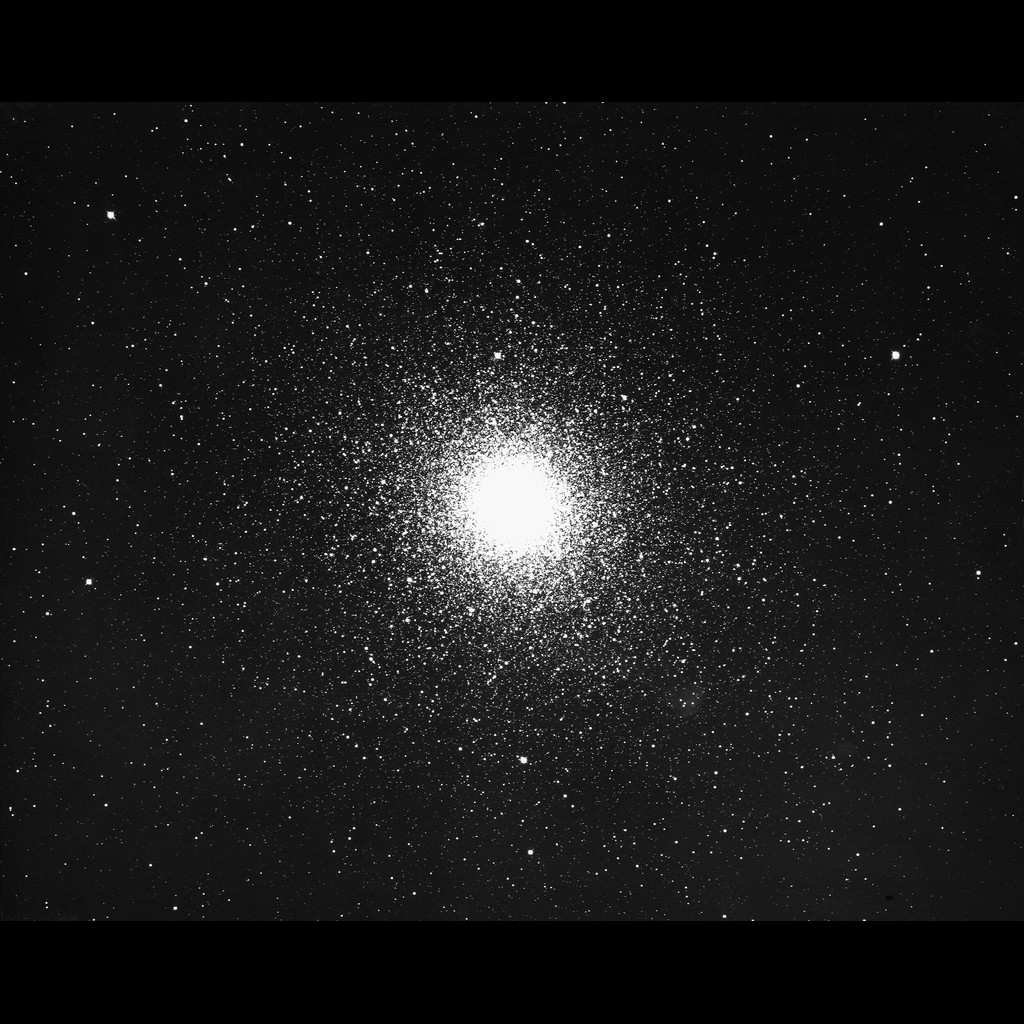
Caldwell 106, better known as 47 Tucanae (or NGC 104), is widely considered the crown jewel of the southern sky’s globular clusters. Located approximately 16,000 light-years away in the constellation Tucana, it is one of the closest and most massive globular clusters in the Milky Way. Visually, it is so bright that it is easily visible to the naked eye, appearing as a slightly fuzzy, fifth-magnitude star. However, through a telescope, it resolves into a breathtaking, densely packed sphere containing millions of stars. Spanning about 210 light-years in diameter and possessing a mass roughly one million times that of our Sun, it is surpassed in size and brilliance only by Omega Centauri.
The cluster is renowned among astronomers for its incredibly dense core. This high-density environment leads to frequent stellar interactions, making 47 Tucanae a "hotspot" for exotic celestial objects. It is home to an unusually high number of millisecond pulsars—rapidly spinning neutron stars—and numerous "blue stragglers," which are stars that appear younger than the rest of the population due to stellar collisions or mergers. Because of its proximity and brightness, 47 Tucanae serves as a primary benchmark for calibrating our understanding of stellar evolution, chemical abundance, and the dynamics of gravity within tightly bound systems.
This historic perspective was captured by the 4-meter Víctor M. Blanco Telescope at the Cerro Tololo Inter-American Observatory (CTIO) in 1975. Even in this early high-resolution photography, the sheer scale of the cluster is evident, showcasing the intense, "blazing" central core where stars are packed so tightly they appear as a singular, luminous mass. This image remains a classic representation of 47 Tucanae, illustrating why it has captivated observers from the era of film photography to the modern digital age as one of the most significant and beautiful structures in the galactic halo.