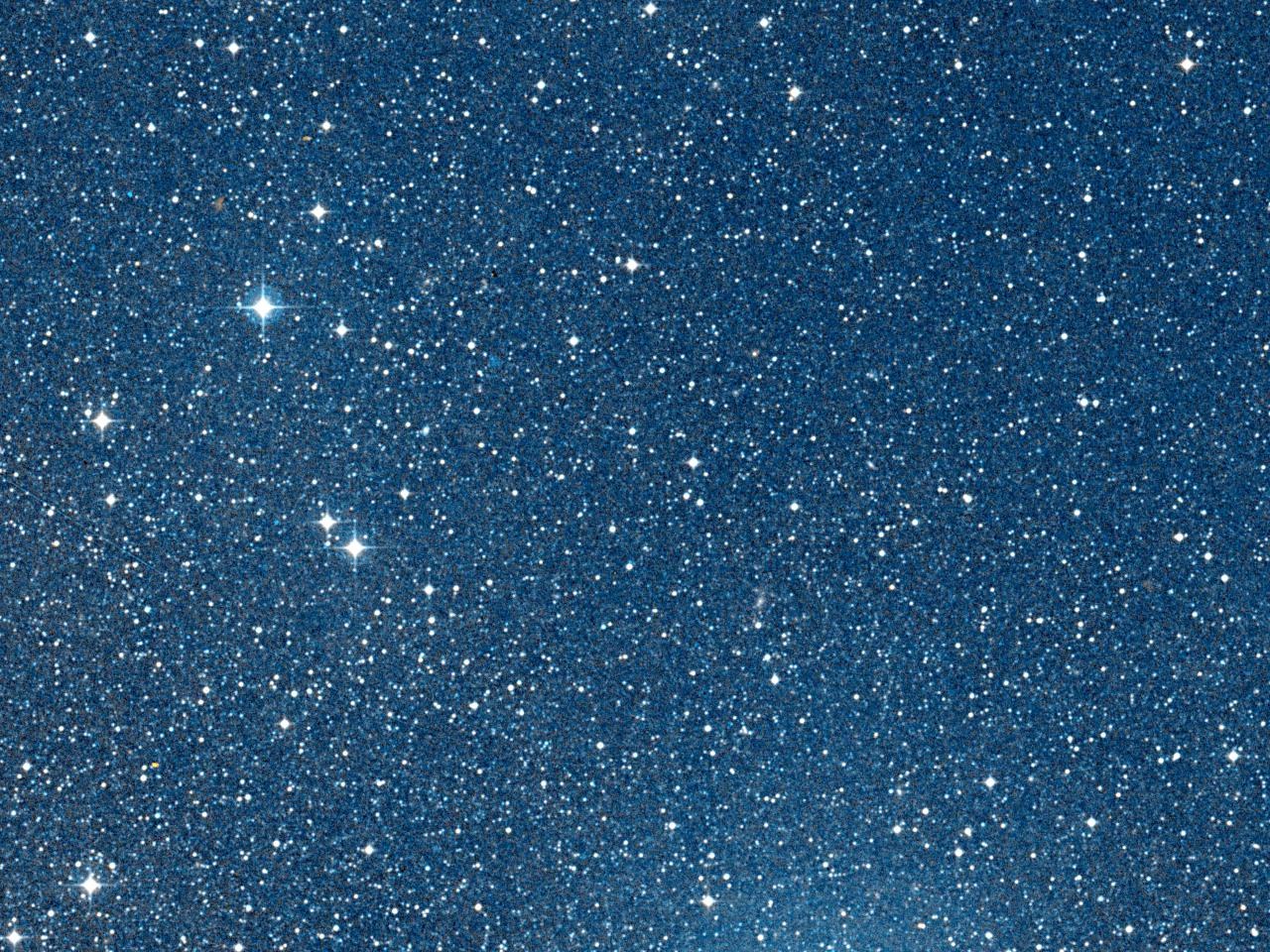
Donald Pelletier / DSS
| Type | Globular Cluster | Constellation | Mus |
|---|---|---|---|
| Magnitude | 7.3 | Size | 13.5′ |
| Distance | 21,200 light-years | Best Month | May |
| Visibility | Southern | Difficulty | Easy (level 2/4) |
| Min. Aperture | binoculars | RA / Dec | 12h 59m 34.8s · -70° 52' 48" |
| Discovered by | Nicolas Louis de Lacaille, 1751 | ||
Donald Pelletier / DSS
Caldwell 105, or NGC 4833, is an ancient and sprawling globular cluster located approximately 21,000 light-years away in the small southern constellation of Musca (The Fly). Positioned near the border of the constellation Centaurus, it is situated in a particularly rich and complex region of the Milky Way’s disk. This cluster is a relic of the early universe, containing hundreds of thousands of stars bound together by gravity in a dense, spherical swarm. Because it is located behind several clouds of interstellar dust, its light is slightly dimmed and "reddened," making it an important subject for astronomers studying how galactic dust affects our view of distant objects.
One of the most notable characteristics of NGC 4833 is its age. It is one of the oldest globular clusters in our galaxy, with some estimates placing its formation at over 12 billion years ago. Unlike younger clusters that may still contain a variety of stellar types, the population of NGC 4833 is composed primarily of evolved, metal-poor stars. Astronomers use this cluster as a "fossil record" to study the chemical conditions that existed when the Milky Way was in its infancy. Its stars serve as a baseline for understanding the nucleosynthesis of the first generations of stars that helped seed the galaxy with heavier elements.
This high-fidelity image was produced by Donald Pelletier using the Aladin Sky Atlas software from the Strasbourg Astronomical Data Center (CDS). While the processing was conducted using this professional software suite, it is important to note that this specific rendering provides a unique perspective beyond the standard survey plates. By carefully managing the stellar data, Pelletier has highlighted the intense concentration of stars within the cluster's core and the delicate "halo" of members that extend into the surrounding star fields. The result is a clean and scientifically grounded portrait of one of the deep south’s most ancient celestial citizens.