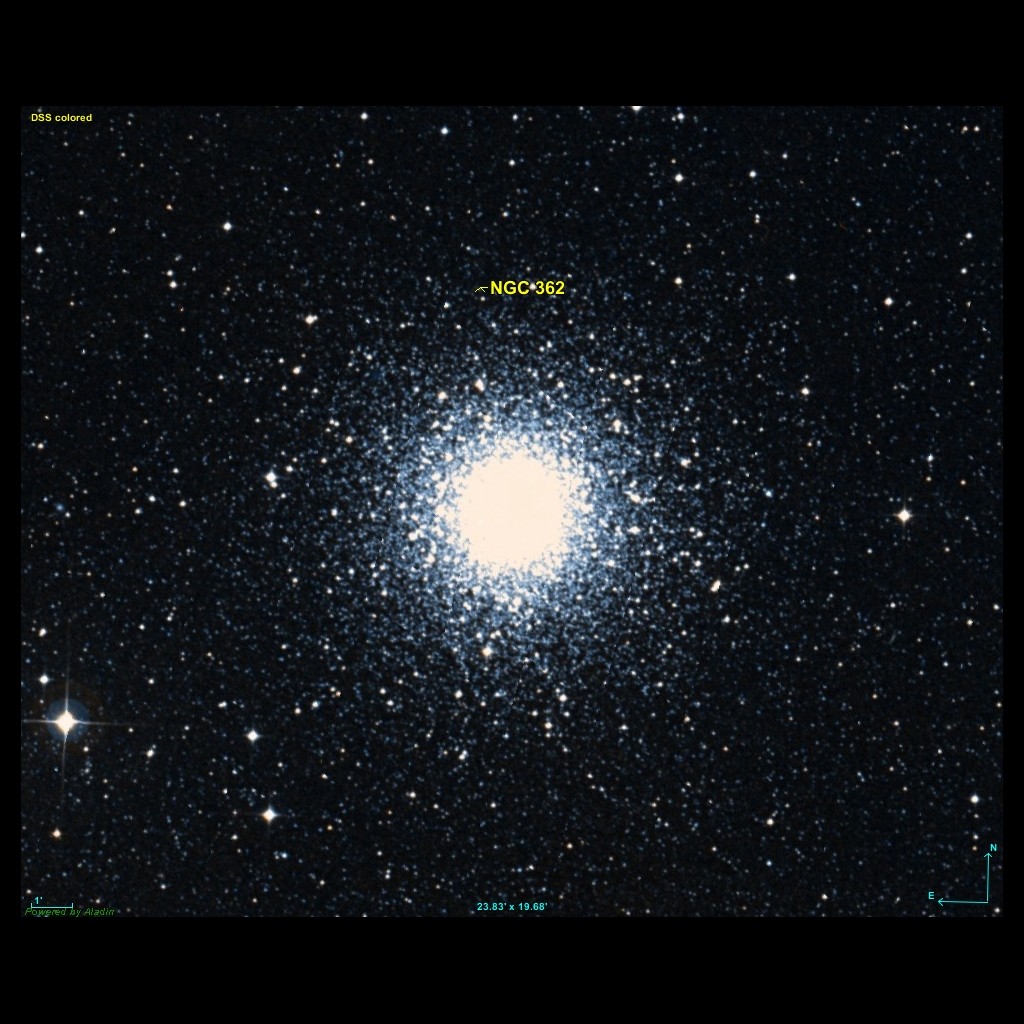
Donald Pelletier / DSS
| Type | Globular Cluster | Constellation | Tuc |
|---|---|---|---|
| Magnitude | 6.4 | Size | 12.9′ |
| Distance | 27,700 light-years | Best Month | November |
| Visibility | Southern | Difficulty | Easy (level 2/4) |
| Min. Aperture | binoculars | RA / Dec | 01h 03m 10.8s · -70° 50' 60" |
| Discovered by | James Dunlop, 1826 | ||
Donald Pelletier / DSS
Caldwell 104, formally known as NGC 362, is a brilliant globular cluster located approximately 29,000 light-years away in the southern constellation of Tucana. Although it appears to sit right on the northern edge of the Small Magellanic Cloud (SMC), it is actually a member of our own Milky Way galaxy, positioned much closer to us than the distant dwarf galaxy behind it. This proximity creates a stunning visual depth, as the tightly packed swarm of ancient stars contrasts against the hazy, sprawling backdrop of the SMC's stellar population. NGC 362 is one of the younger globular clusters in our galaxy’s halo; at roughly 10 billion years old, it is significantly younger than many of its counterparts, such as its famous neighbor 47 Tucanae.
This cluster is particularly noted for its extremely dense and "compact" core. Astronomers classify it as a "core-concentration" cluster, meaning its central stars are packed so tightly that they are difficult to resolve even with professional-grade instruments. Because of this high density, stars near the center frequently interact, leading to a high population of "blue stragglers"—stars that appear younger and hotter than they should be because they have gained mass through collisions or by siphoning material from neighboring stars. These unique stellar inhabitants make NGC 362 a vital subject for studying the dynamic evolution of dense star systems.
This precise and clear view was created by Donald Pelletier using the Aladin Sky Atlas software, developed by the Strasbourg Astronomical Data Center (CDS). The image utilizes scientific data from the Digitized Sky Survey (DSS). By processing these professional survey plates, Pelletier has captured the intense, glowing heart of the cluster and its sprawling outer shell of stars. The rendering highlights the cluster's high degree of symmetry and its distinct presence in the southern sky, providing a classic portrait that honors both the historical data of the DSS and the modern capabilities of digital astronomical tools.