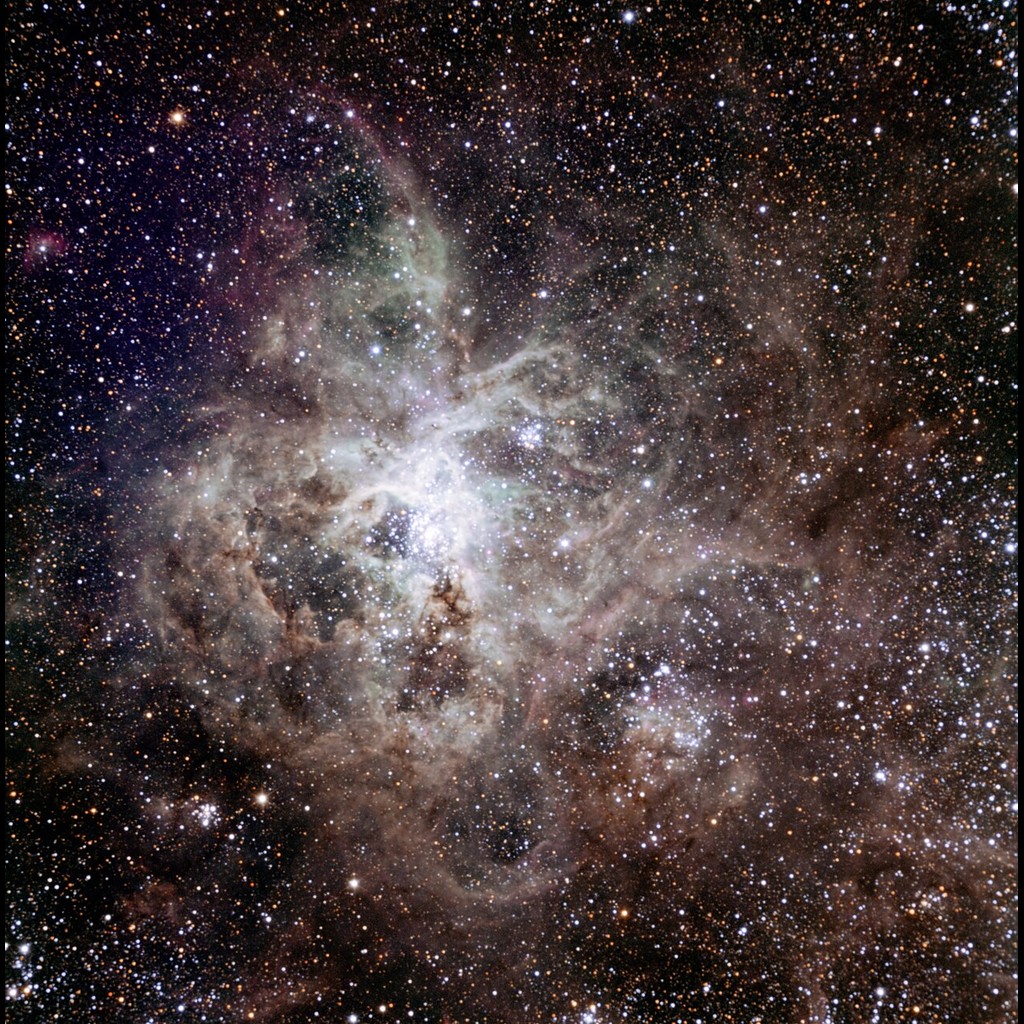
TRAPPIST / E. Jehin / ESO
| Type | Emission Nebula | Constellation | Dor |
|---|---|---|---|
| Magnitude | 8.0 | Size | 40.0′ |
| Distance | 0.16 million light-years | Best Month | January |
| Visibility | Southern | Difficulty | Easiest (level 1/4) |
| Min. Aperture | naked eye | RA / Dec | 05h 38m 42.0s · -69° 05' 60" |
| Discovered by | Nicolas Louis de Lacaille, 1751 | ||
TRAPPIST / E. Jehin / ESO
Caldwell 103, or NGC 2070, is a colossal star-forming region located approximately 160,000 light-years away in the Large Magellanic Cloud (LMC), a satellite galaxy of our own Milky Way. Often called the Tarantula Nebula (or 30 Doradus), it derives its name from its spindly, glowing filaments of gas that resemble the long legs of a giant spider. This nickname is particularly appropriate given the nebula’s terrifyingly massive proportions; spanning nearly 1,000 light-years across, it is the largest and most active star-forming region in the entire Local Group of galaxies. If the Tarantula Nebula were as close to Earth as the Orion Nebula, it would cast shadows on the ground at night and cover a significant portion of the sky.
Scientifically, the Tarantula Nebula is one of the most important "laboratories" in the universe for studying the birth of massive stars. Its immense size and the fact that it is not obscured by the thick dust lanes of the Milky Way’s disk provide astronomers with an exceptionally clear view of its internal structure. At its heart lies a incredibly dense and compact star cluster, R136, which contains some of the most massive and luminous stars ever discovered—several of which exceed 100 times the mass of our Sun. The radiation and powerful stellar winds from these "heavyweights" are responsible for hollowing out the nebula's cavernous voids and ionizing the surrounding hydrogen, making it glow with a brilliance that can be seen across the vast gulf between galaxies.
This "first light" image was captured by the TRAPPIST–South telescope at the La Silla Observatory in Chile. The portrait was created using a combination of data from three spectral filters (Blue, Visual, and Red), covering a field of view of approximately 20 arcminutes. The image showcases the intricate, "web-like" complexity of the nebula's gas clouds and the intense concentration of light at its core. By resolving these bright patches and dark dust lanes, the TRAPPIST–South data provides a vivid look at the violent and beautiful process of star formation on a truly galactic scale.