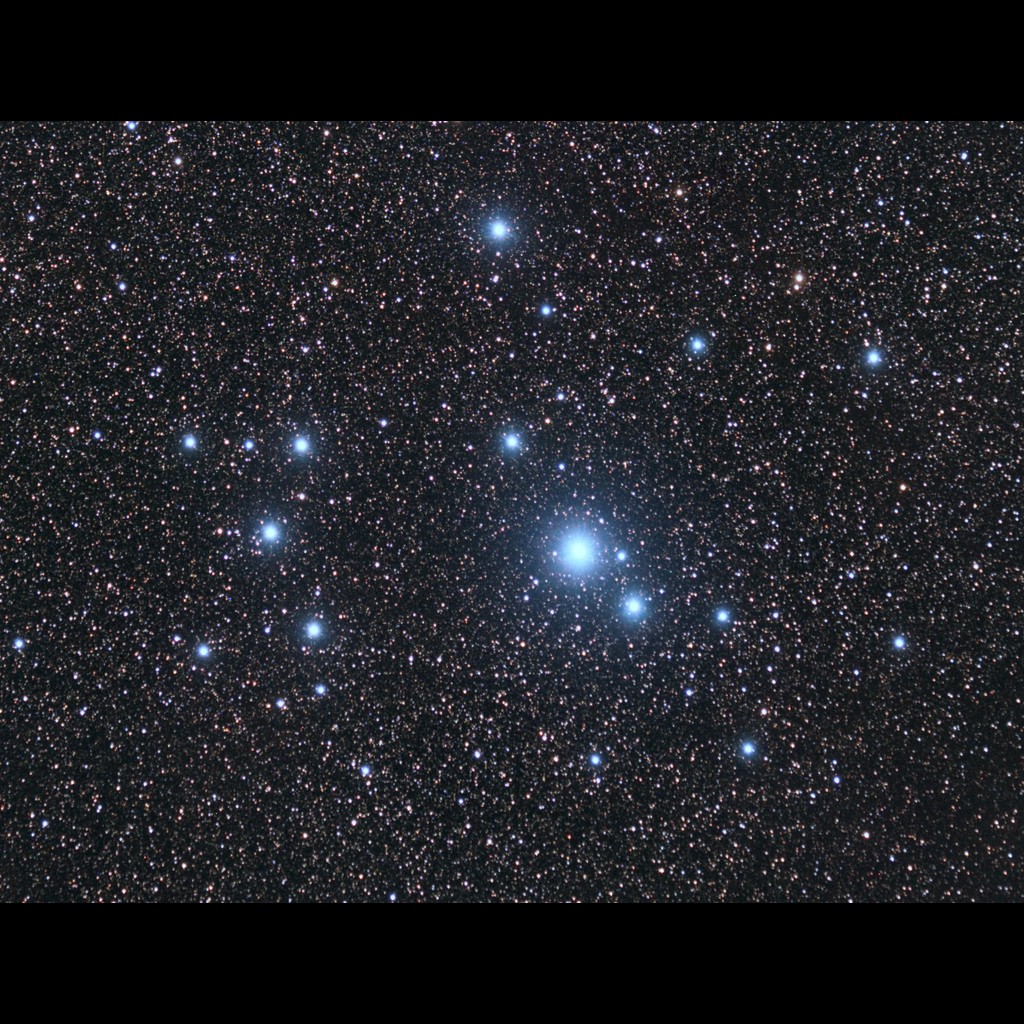
Tel Lekatsas - CC 2.0
| Type | Open Cluster | Constellation | Car |
|---|---|---|---|
| Magnitude | 1.9 | Size | 50.0′ |
| Distance | 479 light-years | Best Month | March |
| Visibility | Southern | Difficulty | Easiest (level 1/4) |
| Min. Aperture | naked eye | RA / Dec | 10h 43m 01.2s · -64° 24' 00" |
| Discovered by | Nicolas Louis de Lacaille, 1751 | ||
Tel Lekatsas - CC 2.0
Caldwell 102, officially cataloged as IC 2602, is one of the most brilliant and easily observed open clusters in the southern hemisphere. Located approximately 480 light-years away in the constellation Carina, it is popularly known as the Southern Pleiades. This nickname is well-earned, as the cluster bears a striking resemblance to the famous M45 (Pleiades) in the northern sky. It is dominated by the second-magnitude blue-white star Theta Carinae, which acts as the "anchor" for the cluster, much like Alcyone does for its northern counterpart. Visually, the cluster is a sprawling, bright group that is roughly 70% as large as the northern Pleiades, making it a spectacular target for binoculars and small telescopes.
At roughly 50 million years old, IC 2602 is a relatively young stellar family. It consists of about 60 stars that formed from the same massive cloud of molecular gas. Because these stars are so young and hot, they emit a powerful blue light, characteristic of "B-type" stars. For astronomers, the Southern Pleiades is a significant object for studying the early evolution of stars and the dynamics of open clusters. Its proximity to Earth allows for high-precision measurements of its members' chemical compositions and rotational velocities, providing a baseline for understanding how young stellar groups eventually disperse into the general population of the Milky Way galaxy.
This crisp portrait of the cluster was captured by Tel Lekatsas using the iTelescope T13 located at Siding Springs, Australia. The image is a result of a 30-minute total integration time, comprised of six individual 300-second exposures taken on April 11, 2013. The wide-field perspective of the T13 telescope perfectly captures the "sparkling" nature of the cluster members, centered around the brilliant Theta Carinae. By utilizing the dark, high-altitude skies of Siding Springs, this photograph highlights the intense blue-white radiance of the stars against the deep black of the Carina star fields, immortalizing the group's reputation as a southern celestial treasure.