Dark Energy Survey/DOE/FNAL/DECam/CTIO/NOIRLab/NSF/AURA
| Type | Galaxy | Constellation | Pav |
|---|---|---|---|
| Magnitude | 8.3 | Size | 20.0′ |
| Distance | 30.0 million light-years | Best Month | August |
| Visibility | Southern | Difficulty | Easy (level 2/4) |
| Min. Aperture | binoculars | RA / Dec | 19h 09m 46.8s · -63° 51' 00" |
| Discovered by | James Dunlop, 1826 | ||
Dark Energy Survey/DOE/FNAL/DECam/CTIO/NOIRLab/NSF/AURA
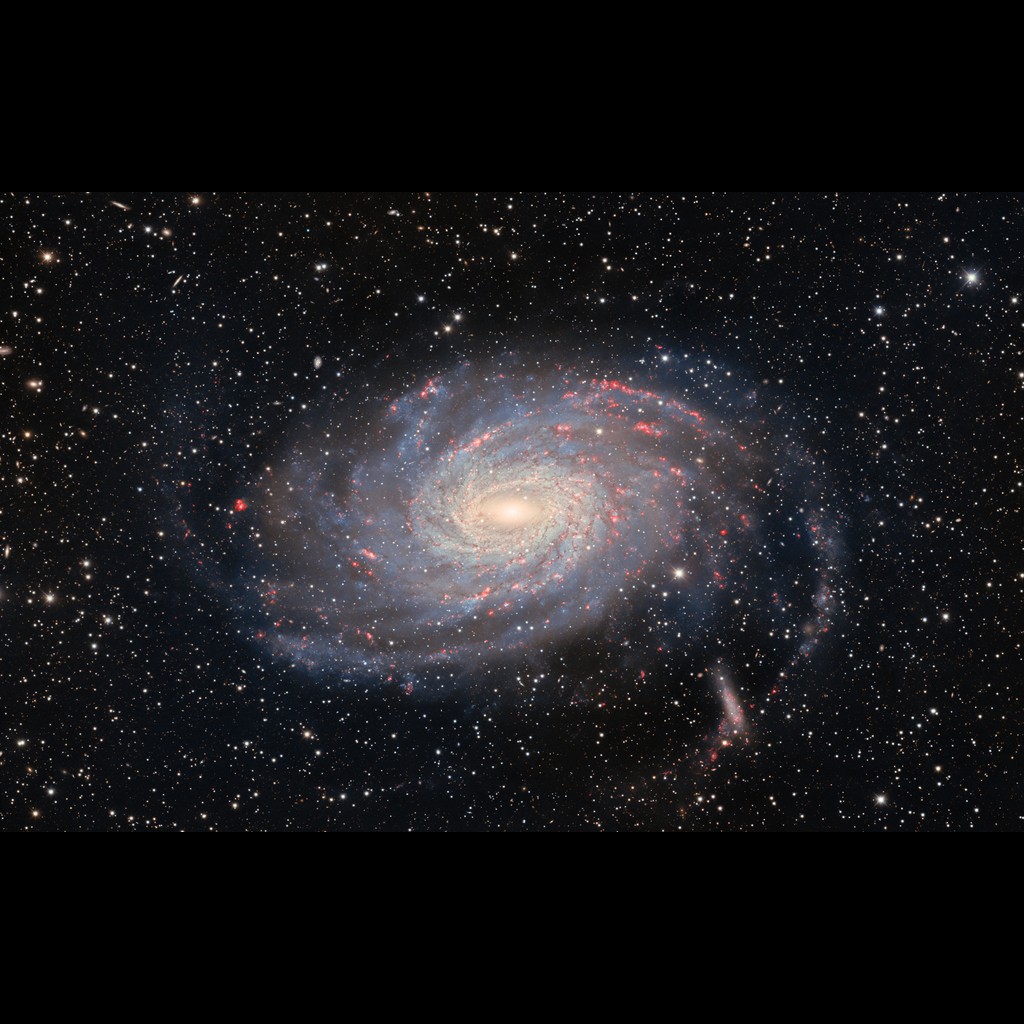
Caldwell 101, or NGC 6744, is one of the most majestic spiral galaxies in the southern sky, located approximately 30 million light-years away in the constellation Pavo. It is frequently referred to as the "Milky Way's Twin" because its structure closely mirrors our own home galaxy. Spanning a massive 175,000 light-years across—making it significantly larger than the Milky Way—it features a brilliant, yellowish core of old stars and graceful, winding spiral arms. For astronomers, this galaxy acts as a giant cosmic mirror; since we cannot step outside the Milky Way to photograph it from afar, studying NGC 6744 provides a unique perspective on what our own galactic home might look like to a distant observer.
The similarities between our two galaxies extend beyond just their spiral shapes. To the lower right of NGC 6744, located at the tip of one of its sweeping spiral arms, is a faint, irregular "blob" known as NGC 6744A. This smaller companion galaxy serves as a direct analog to the Large Magellanic Cloud, the dwarf galaxy that orbits our own Milky Way. The relationship between these two systems offers vital clues into how large spiral galaxies interact with and influence their smaller neighbors, highlighting the dynamic nature of galactic companionship across millions of light-years.
This portrait is one of the deepest and most detailed images of NGC 6744 ever captured. It was taken using the Dark Energy Camera (DECam) on the Víctor M. Blanco 4-meter Telescope at the Cerro Tololo Inter-American Observatory (CTIO) in Chile. The sensitivity of the DECam allows for the detection of incredibly faint structures, such as the extended spiral arm on the right-hand side of the galaxy, which is rarely resolved in most photographs. By capturing these subtle features and the luminous dust lanes weaving through the arms, the image provides a profound look at the anatomy of a grand-design spiral galaxy in its full glory.