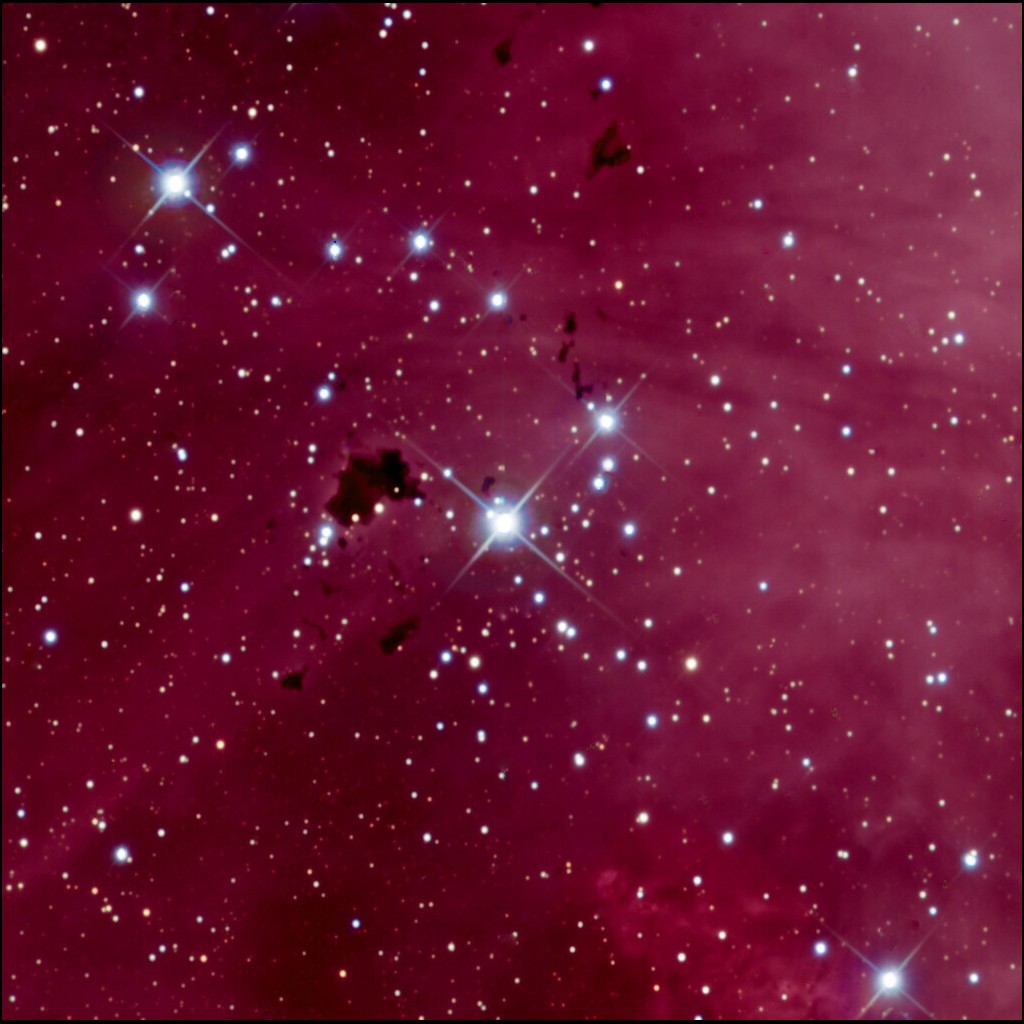
SSRO/PROMPT and NOIRLab/NSF/AURA
| Type | Open Cluster | Constellation | Cen |
|---|---|---|---|
| Magnitude | 4.5 | Size | 15.0′ |
| Distance | 5,900 light-years | Best Month | May |
| Visibility | Southern | Difficulty | Easiest (level 1/4) |
| Min. Aperture | naked eye | RA / Dec | 11h 35m 60.0s · -63° 01' 12" |
| Discovered by | Nicolas Louis de Lacaille, 1751 | ||
SSRO/PROMPT and NOIRLab/NSF/AURA
Caldwell 100, or IC 2944, is a vibrant emission nebula located approximately 5,900 light-years away in the constellation Centaurus. This region is a massive clouds of ionized gas fueled by the intense energy of young, hot stars. Centaurus is home to some of the most luminous stars in the galaxy, which flood the area with immense quantities of ultraviolet radiation. This high-energy light strips electrons from the surrounding hydrogen gas, causing the nebula to glow with its characteristic rosy hue. While often nicknamed the "Running Chicken Nebula" due to the bird-like shape some observers perceive in its brightest ridges, the nebula is a scene of intense cosmic erosion.
A fascinating and scientifically significant feature of IC 2944 is the presence of small, opaque silhouettes known as Thackeray’s Globules. These structures are the resilient remains of a much larger dark nebula that has been steadily blasted and eroded by the surrounding UV radiation. These dense clumps of gas and dust, some spanning roughly 1.4 light-years in width, are a specific type of Bok globule. They are often the sites of future star birth, though in the harsh environment of IC 2944, they are being whittled away by the stellar winds of nearby giants, creating a dynamic struggle between the formation of new stars and the destruction of the material needed to create them.
This detailed image was produced through a collaboration between SSRO/PROMPT and NOIRLab/NSF/AURA. The high-resolution data captures the delicate, "smoke-like" appearance of Thackeray’s Globules as they stand out against the glowing backdrop of the ionized gas. By highlighting the contrast between the dark, cold dust and the brilliant emission nebula, the portrait illustrates the transformative power of massive stars on their environment. It serves as a striking conclusion to the hundredth entry in the Caldwell catalog, showcasing the complex beauty of a stellar nursery under siege.