ESO
| Type | Dark Nebula | Constellation | Cru |
|---|---|---|---|
| Magnitude | — | Size | 420.0′ |
| Distance | 600 light-years | Best Month | May |
| Visibility | Southern | Difficulty | Easiest (level 1/4) |
| Min. Aperture | naked eye | RA / Dec | 12h 31m 58.8s · -63° 00' 00" |
| Discovered by | Vicente Yáñez Pinzón, 1499 | ||
ESO
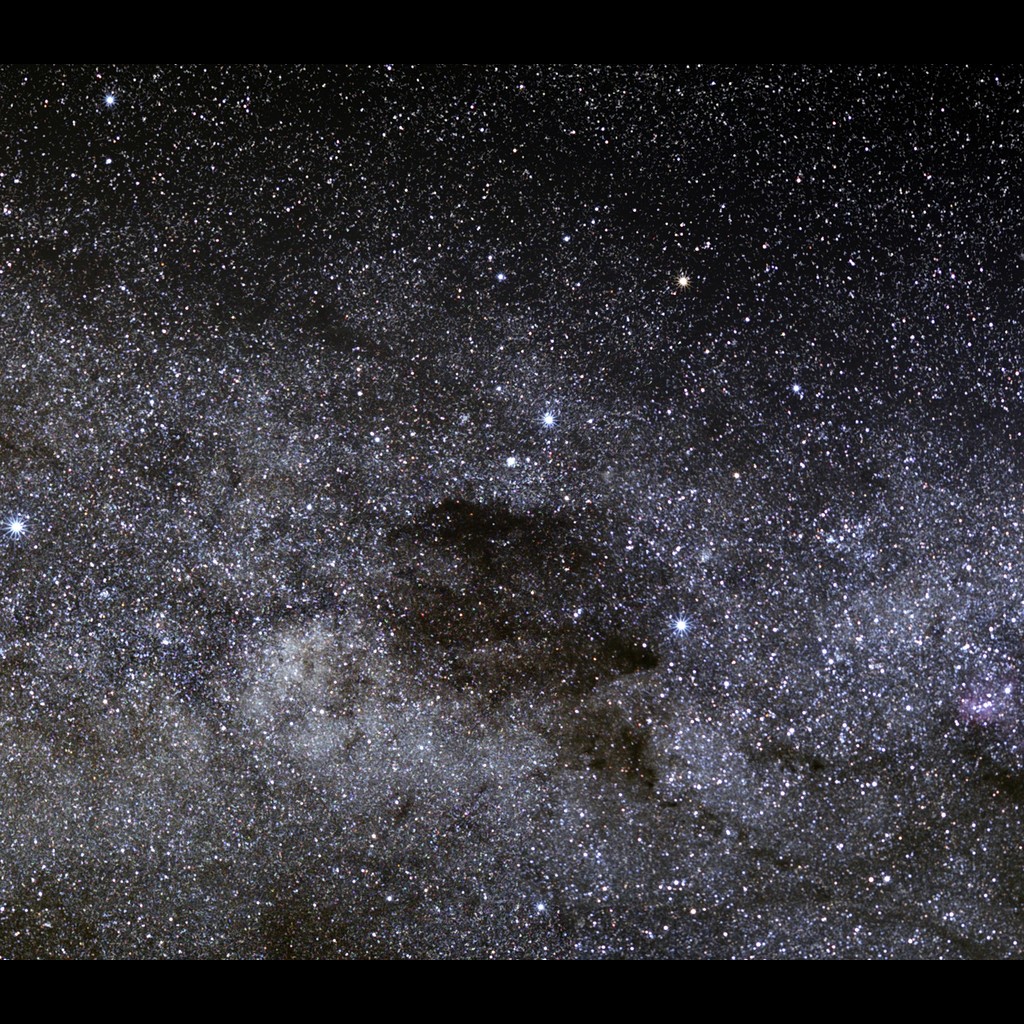
Caldwell 99, famously known as the Coalsack Nebula, is one of the most striking and recognizable dark nebulae in the night sky. Located approximately 600 light-years away in the southern constellation of Crux, it appears to the unaided eye as a prominent, starless void silhouetted against the brilliant, crowded stripe of the Milky Way. Far from being "empty" space, this seemingly starless dark patch is actually an opaque interstellar dust cloud that obscures the light of the background stars. The dust grains within the cloud redden the starlight that reaches us by absorbing blue light preferentially, so that the stars shimmering in the northern and darkest part of the Coalsack appear more crimson than they would in the absence of this dense material.
This remarkable object has been a source of wonder for centuries and was likely first observed by European explorers like the Spanish navigator Vicente Yáñez Pinzón during his 1499 voyage to South America. By the 16th century, it had earned the nickname "Black Magellanic Cloud," as it rivaled the prominence of the bright dwarf galaxies seen in the Southern Hemisphere. Its presence is so distinct that it features heavily in Indigenous Australian and South American lore, where it is often seen not as a void, but as a physical form within a "Great Emu" or other celestial figures defined by the dark spaces of the galaxy rather than its bright stars.
Incan mythology offers a particularly spirited explanation for the nebula’s origin, involving the god Ataguchu. Legend has it that in a fit of temper, Ataguchu kicked the Milky Way, causing a fragment to fly off and form the Small Magellanic Cloud while leaving behind the dark, bruised mark of the Coalsack. This image from the ESO captures the "inky" depth of the cloud, illustrating how it effectively blocks the background starlight to create a profound silhouette. It remains a testament to the fact that in astronomy, what we cannot see is often just as significant as the light that reaches our eyes, serving as a reminder to always beware of Inca gods in a bad mood.