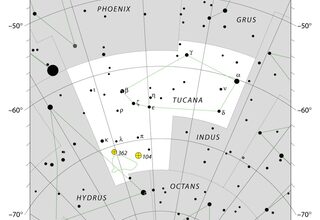
 IAU Chart
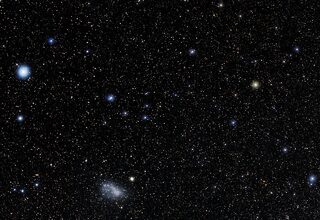 NOIRLab Images
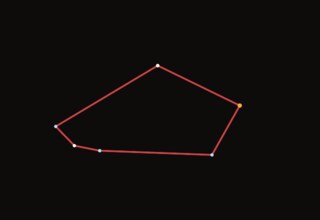 Stars and Sticks
| Abbreviation | Tuc |
|---|---|
| Meaning | Toucan |
| Pronunciation Guide is based on “Pronouncing Astronomical Names,” published in 1943 by the American Astronomical Society. | too-KAY-nuh |
| Genitive The genitive is the Latin possessive form used in star names. For example, Alpha Orionis means “the Alpha of Orion.” | too-KAY-nee |
| Best Month | November |
| Visibility | Southern |
| Origin | ExplorationCreated by 16th-century Dutch navigators (Keyser & de Houtman) to fill the blank spaces of the southern sky during their voyages to the East Indies. |
| Author | Keyser & de HoutmanDutch explorers whose southern star observations during the first Dutch expedition to the East Indies provided the data for 12 new constellations. |
| Type | constellation |
| Difficulty | Challenging |
| Description | The Toucan was created by Dutch navigators in the 1590s to represent the spectacularly billed tropical bird of South America encountered during their voyages. Within its borders lies the Small Magellanic Cloud (SMC) — the smaller of the two satellite galaxies of the Milky Way, about 200,000 light-years away and visible to the naked eye as a detached patch of sky from the southern hemisphere. Nearby lies 47 Tucanae (NGC 104) — the second most spectacular globular cluster in the sky after Omega Centauri, a dense ball of hundreds of thousands of ancient stars that appears as a fuzzy naked-eye star, making Tucana one of the richest constellations for remarkable objects despite its faintness. |
Click a thumbnail to view full-size. Plain and Annotated versions available on the image page.
Images: NOIRLab/NSF/AURA/E. Slawik · IAU and Sky & Telescope · Stellarium — Full credits →