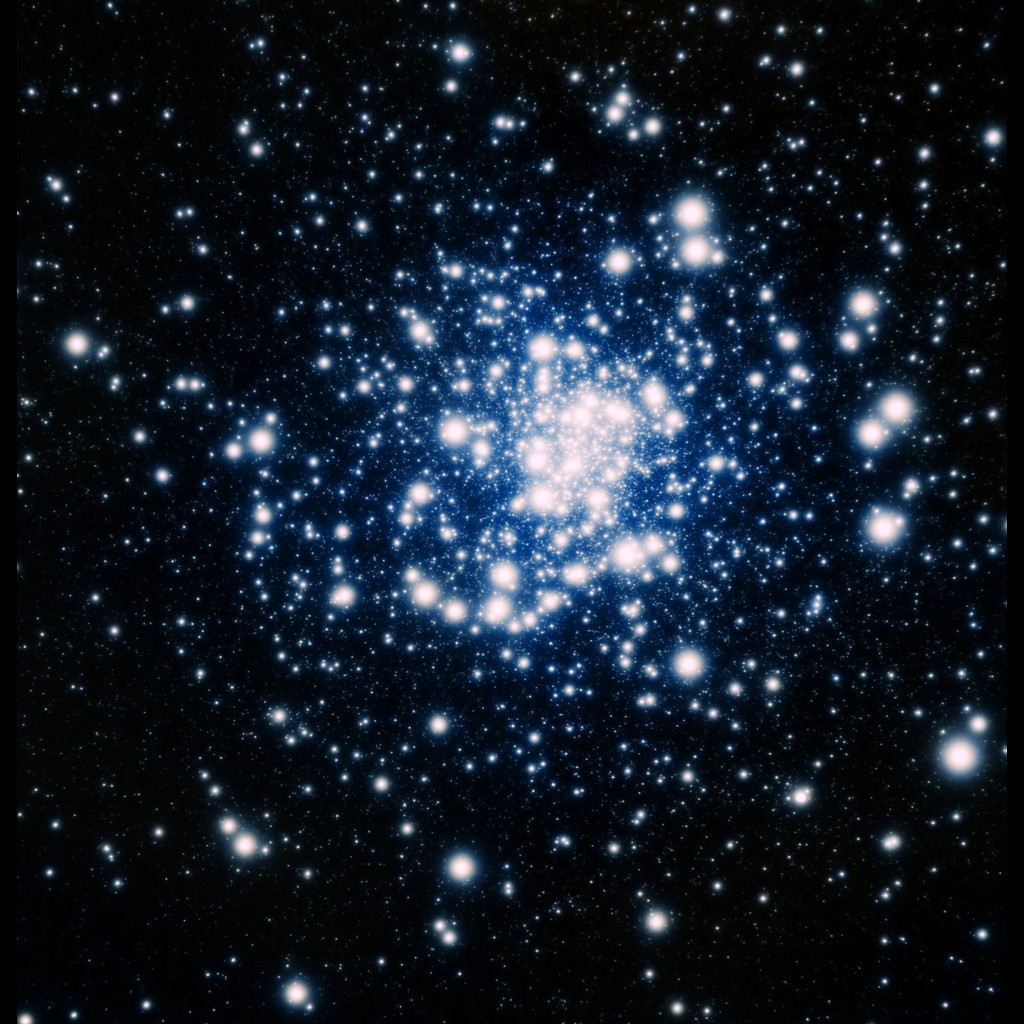
International Gemini Observatory, Alan McConnachie (Herzberg Institute of Astrophysics) and T.A. Rector (University of Alaska Anchorage)
| Type | Globular Cluster | Constellation | Col |
|---|---|---|---|
| Magnitude | 7.3 | Size | 11.0′ |
| Distance | 39,500 light-years | Best Month | January |
| Visibility | Southern | Difficulty | Easy (level 2/4) |
| Min. Aperture | binoculars | RA / Dec | 05h 13m 58.8s · -40° 02' 60" |
| Discovered by | James Dunlop, 1826 | ||
International Gemini Observatory, Alan McConnachie (Herzberg Institute of Astrophysics) and T.A. Rector (University of Alaska Anchorage)
Caldwell 73, or NGC 1851, is a remarkably dense and ancient globular star cluster situated approximately 40,000 light-years away in the southern constellation of Columba. Known for its extremely high central concentration, it is classified as a Shapley-Sawyer Class II cluster, meaning its core is so tightly packed that individual stars are nearly impossible to resolve with standard ground-based equipment. This massive assembly of hundreds of thousands of stars serves as a "fossil" from the early history of our galaxy, with an estimated age of over 10 billion years.
What makes NGC 1851 particularly intriguing to astronomers is the discovery that it may actually be two clusters in one. Research into its stellar populations reveals two distinct groups of stars with different chemical signatures and ages, suggesting that C73 could be the result of a rare "merger" between two separate globular clusters. Alternatively, some theories suggest it may be the stripped-down nucleus of a dwarf galaxy that was long ago consumed by the Milky Way, similar to the origin story of the massive Omega Centauri.
This near-infrared image was obtained using the Gemini Multi-conjugate adaptive optics System (GeMS) on the Gemini South telescope in Chile. By using adaptive optics to compensate for the blurring effects of Earth's atmosphere, the system successfully resolves the individual stars deep inside the cluster's crowded core. The near-infrared perspective allows astronomers to peer through any lingering dust and clearly distinguish the ancient, cooler red giant stars from the denser population of main-sequence stars, providing a high-definition look at one of the most complex gravitational environments in our galactic halo.