T.A.Rector/NOIRLab/NSF/AURA/
| Type | Galaxy | Constellation | Scl |
|---|---|---|---|
| Magnitude | 7.9 | Size | 32.4′ |
| Distance | 6.5 million light-years | Best Month | November |
| Visibility | Southern | Difficulty | Easy (level 2/4) |
| Min. Aperture | binoculars | RA / Dec | 00h 12m 54.0s · -39° 11' 24" |
| Discovered by | James Dunlop, 1826 | ||
T.A.Rector/NOIRLab/NSF/AURA/
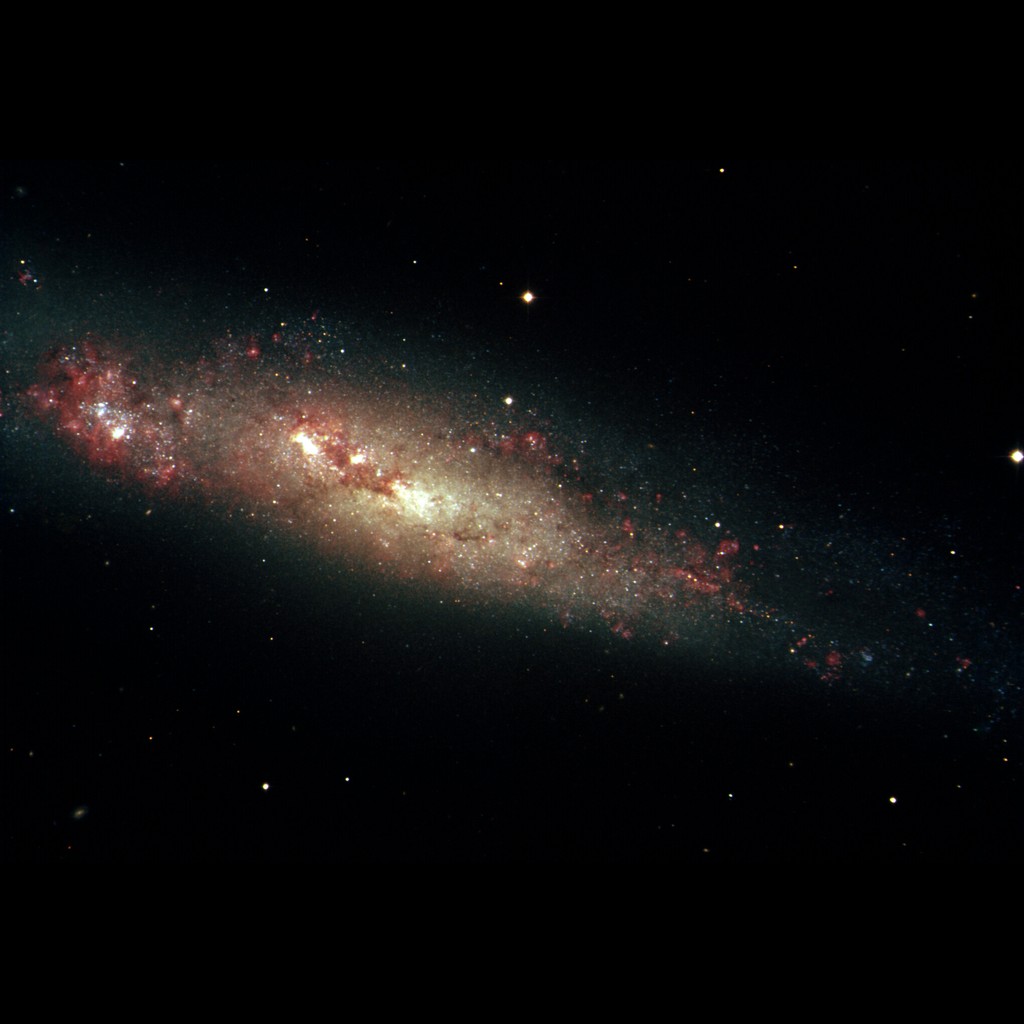
Caldwell 72, or NGC 55, is a spectacular barred irregular galaxy located approximately five million light-years away in the constellation Sculptor. It resides within the Sculptor Group, a gathering of galaxies that ranks as one of the closest groups to our own Local Group. Because it is oriented nearly edge-on from our perspective, the galaxy appears as a long, asymmetrical streak of light. Its structure is often compared to the Large Magellanic Cloud, featuring a disordered disk and an off-center core that gives it a unique, "whale-like" profile in the night sky.
The galaxy is a hotbed of stellar activity, characterized by a high rate of star birth. Scattered across its length are numerous red nebulosities—vibrant HII regions where massive clouds of molecular hydrogen are collapsing to form new suns. These "stellar nurseries" are ionized by the intense ultraviolet radiation of newborn stars, causing them to glow brilliantly in the crimson part of the spectrum. These regions, combined with the bright blue clusters of young stars, create the "String of Pearls" effect that makes this galaxy a favorite for both professional research and amateur astrophotography.
This image of NGC 55 was captured using the National Science Foundation's 0.9-meter telescope at the Cerro Tololo Inter-American Observatory (CTIO) in Chile. The high-resolution data from this Southern Hemisphere vantage point reveals the intricate web of dust lanes and the clumpy texture of the star-forming regions that dominate the galaxy’s disk. Spanning nearly the width of a full moon in the sky, Caldwell 72 serves as a premier example of a nearby "island universe" undergoing a period of intense and chaotic growth.