Guillermo Abramson - CCA 3.0
| Type | Open Cluster | Constellation | Pup |
|---|---|---|---|
| Magnitude | 5.8 | Size | 27.0′ |
| Distance | 4,000 light-years | Best Month | February |
| Visibility | Southern | Difficulty | Easiest (level 1/4) |
| Min. Aperture | naked eye | RA / Dec | 07h 52m 22.8s · -38° 32' 60" |
| Discovered by | Nicolas Louis de Lacaille, 1751 | ||
Guillermo Abramson - CCA 3.0
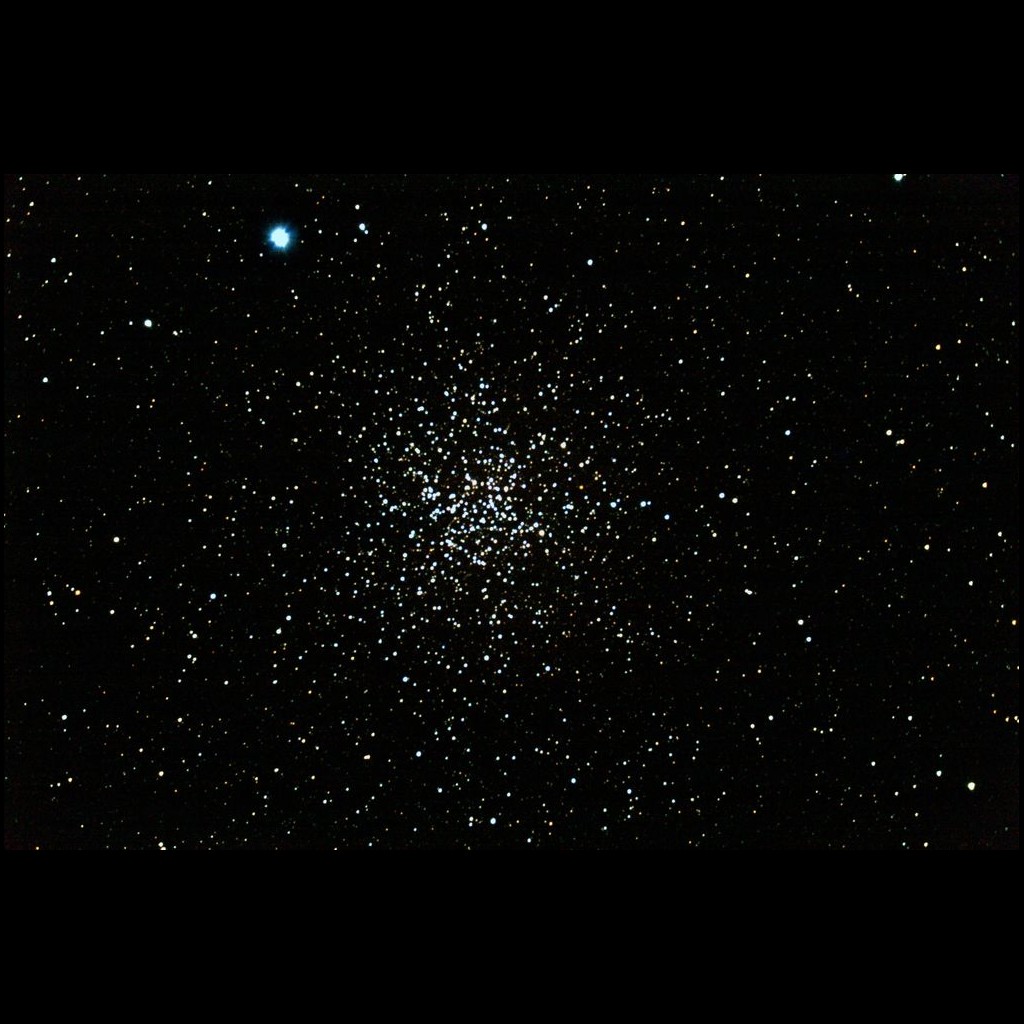
Caldwell 71, or NGC 2477, is a remarkably dense and populous open cluster located approximately 3,700 light-years away in the constellation Puppis. It is often cited as one of the finest open clusters in the sky, containing over 300 stars in a compact arrangement that spans roughly 20 light-years. Because its stars are so tightly packed, it can easily be mistaken for a globular cluster at lower magnifications; however, it lacks the intense central concentration and extreme age characteristic of globular systems, with an estimated age of about one billion years.
The cluster is notable for its rich variety of stellar colors and magnitudes, which become apparent through dedicated astrophotography. While many open clusters are dominated by young, blue-white stars, NGC 2477 has reached a middle-aged stage where its more massive members have begun to evolve off the main sequence. This transition creates a complex "Hertzsprung-Russell diagram" for the cluster, revealing a mix of white, yellow, and orange stars that provide critical data for astronomers studying the long-term evolution of star clusters within the galactic disk.
This specific view was captured from Bariloche, Argentina, utilizing a stack of eight 60-second exposures at ISO 400. Taken at the prime focus of a Meade LX10 telescope with a Canon XTi, the imaging setup effectively resolves the cluster's dense core against the rich backdrop of the Milky Way. The Southern Hemisphere vantage point provides a high-altitude, clear-sky perspective of this cluster, allowing the individual points of light to pierce through the surrounding nebulosity of the Puppis region and highlighting the "sparkling" quality that makes it a favorite for visual observers and photographers alike.