ESO
| Type | Galaxy | Constellation | Scl |
|---|---|---|---|
| Magnitude | 8.7 | Size | 21.9′ |
| Distance | 6.07 million light-years | Best Month | November |
| Visibility | Southern | Difficulty | Easy (level 2/4) |
| Min. Aperture | binoculars | RA / Dec | 00h 54m 54.0s · -37° 40' 48" |
| Discovered by | James Dunlop, 1826 | ||
ESO
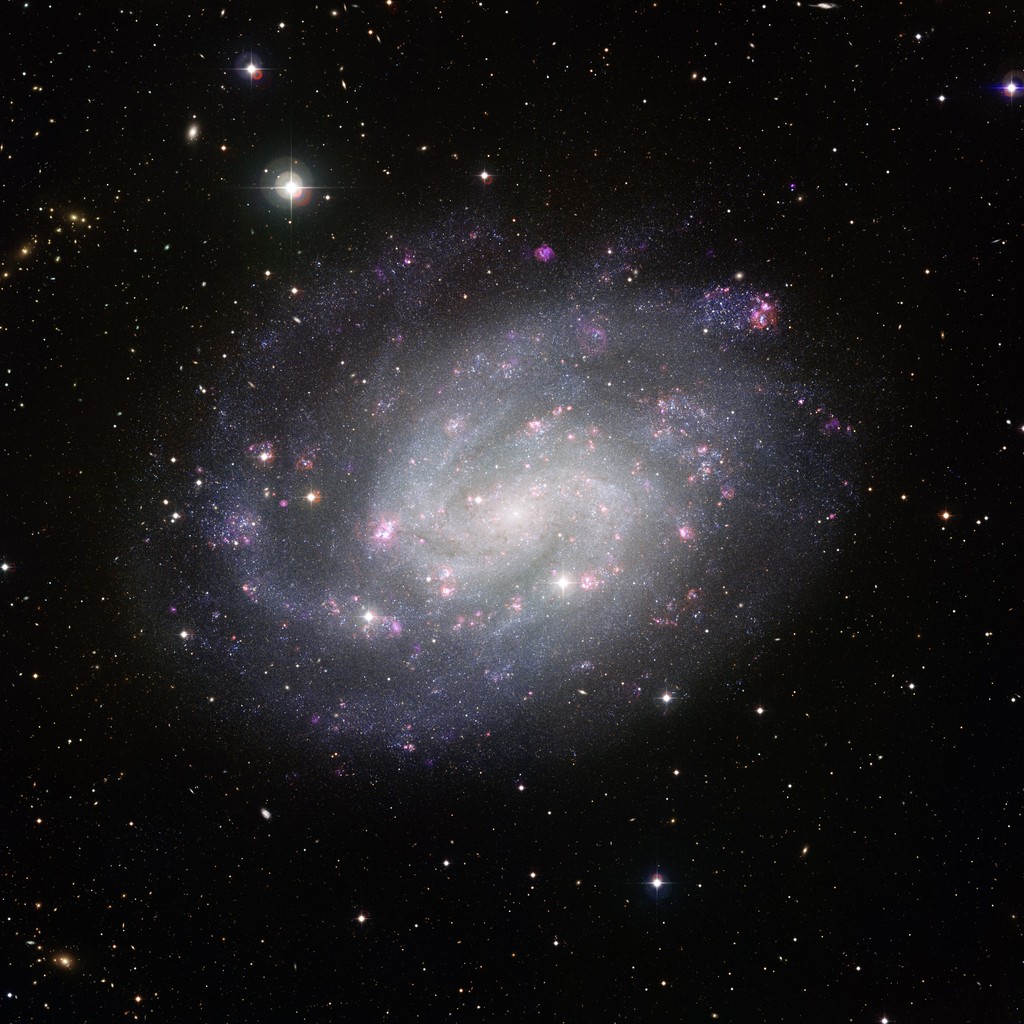
Caldwell 70, or NGC 300, is a bright spiral galaxy located approximately 6 million light-years away in the constellation Sculptor. It is one of the closest galaxies beyond our Local Group and serves as a prominent member of the Sculptor Group of galaxies. Because it is oriented nearly face-on from our perspective, it provides an unobstructed view of its expansive spiral structure, which bears a striking resemblance to the Triangulum Galaxy (M33). Its relative proximity and clear orientation make it a primary target for astronomers studying the life cycles of stars and the chemical composition of the interstellar medium.
The galaxy is characterized by its organized but "clumpy" spiral arms, which are populated by a vast number of young, hot blue stars and glowing HII regions. Unlike many galaxies with dense, bright cores, NGC 300 has a more diffuse nucleus, and its star formation is spread evenly throughout its disk rather than being concentrated in a single burst. This steady rate of star birth has allowed for the formation of diverse stellar populations, including a well-known X-ray binary system consisting of a Wolf-Rayet star and a black hole—one of the most massive stellar-mass black holes ever discovered.
High-resolution imaging of NGC 300, such as that provided by wide-field surveys and space-based observatories, reveals the intricate details of its dust lanes and the individual stars within its clusters. These observations have been instrumental in refining the cosmic distance scale, as the galaxy contains many Cepheid variables—stars that act as "standard candles" for measuring distances in the universe. For the observer, its large apparent size (nearly two-thirds the width of the full moon) and low surface brightness require dark skies to fully appreciate the delicate, swirling architecture of this neighboring island universe.