Questions & terms
Questions people ask
Why are some planets dimmed?
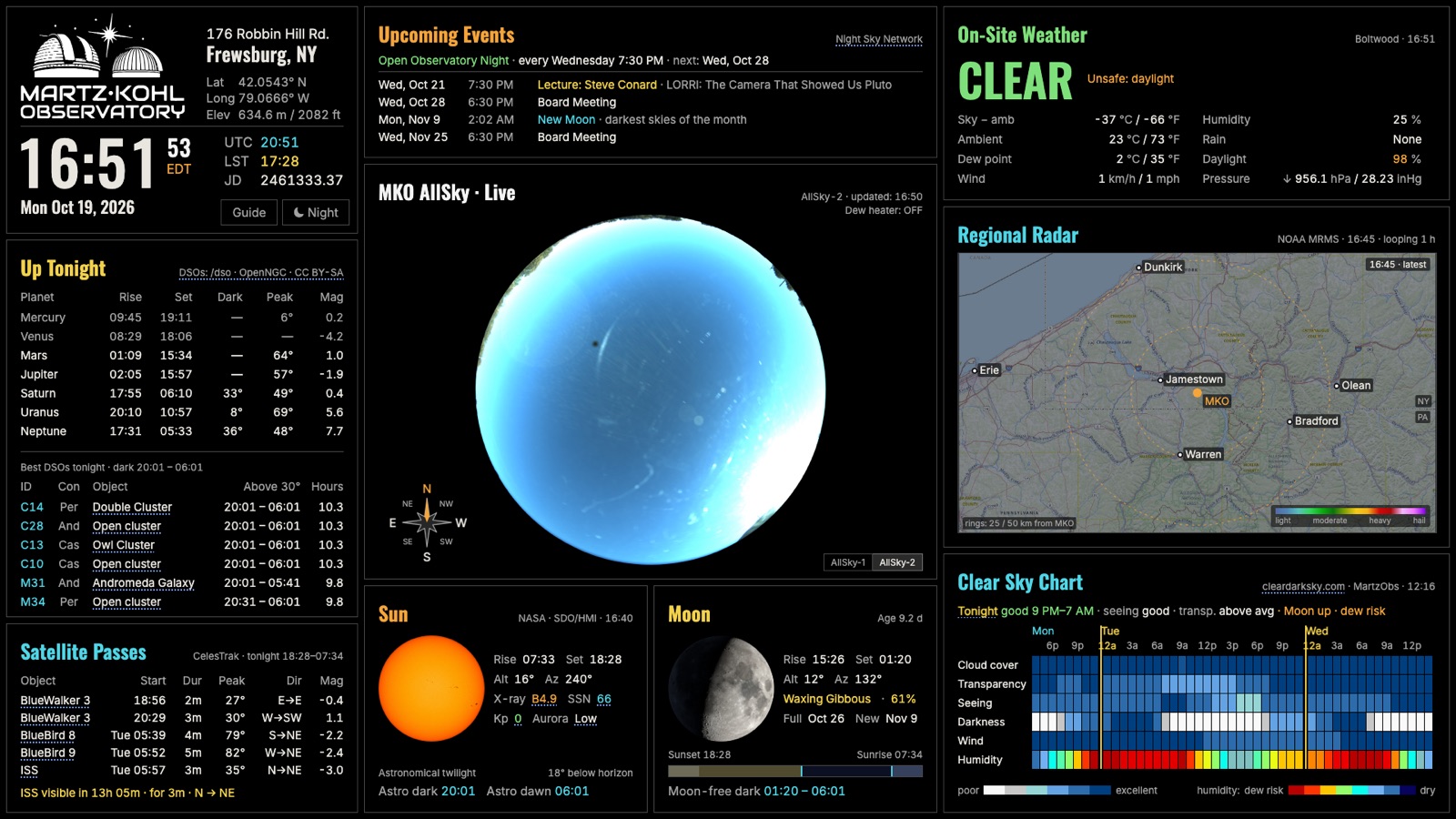
A bright row means the planet is viewable tonight: at least 10° above the horizon at some time from now until sunrise (twilight counts as night). A dim row is not: it stays low or below the horizon. Hover over a row to see the viewing window, or why it is dim.
How do I read the deep-sky table?
It is a planning list for imaging: ID is the catalog number, Con the constellation and Object the name; 'Above 30°' gives the first and last time tonight (in the dark) that the object is at least 30° up, and Hours how long that is. The objects with the longest time up come first, so a long window means a relaxed evening and a short one means it is only up briefly. A name like 'Open cluster' is the catalog's own generic description.
What do Dark and Peak mean in the planets table?
Dark is the planet's height an hour after full darkness begins, or right now once it is dark; Peak is the highest it gets tonight. A dash means it is below the horizon then.
Why do the planets' Rise and Set times show no day?
For a planet below the horizon they are its next rise and the set after it, which may well be tomorrow. For a planet that is up, they are the rise that already happened and the coming set.
What does orange text in a panel's header mean?
That panel's data is getting old, for example 'Boltwood · 25 min old'. The dashboard would rather show you the age than pretend old data is fresh.
What is the warning where the date normally is?
The whole dashboard has stopped updating, or the server can't be reached. Without it, numbers such as the Sun's altitude would freeze while the clock keeps ticking.
Does 'Safe to open roof' control anything?
No. It is advice worked out from the Boltwood sensor's readings and its own limits (cloud, wind, daylight, rain, humidity, pressure, sensor voltage). The dashboard never controls the roof, the dome or the telescope; always use your own judgement.
Why does the Sun picture name different sources?
Three sources supply pictures of the Sun (NASA's SDO, the SOHO mirror, and Helioviewer) and the dashboard uses whichever has the newest. Helioviewer's picture is grayscale, so it is tinted orange to match NASA's. Helioviewer's can be a few hours behind; the others are usually minutes behind.
Why does AllSky-2 show a Dew heater line?
AllSky-2's dome has a heater that keeps dew and frost off it. It runs from 30 minutes before sunset until sunrise, and the camera's Raspberry Pi reports its state every 2 minutes. If the reports stop, the line turns orange ('no update').
Why is the AllSky picture smaller at night?
AllSky-2's camera changes its settings at night (it combines pixels, called binning), which makes a smaller picture. The dashboard accepts both sizes and shows the same circle.
Why is the bottom of AllSky-1's circle cut flat?
AllSky-1's camera frame ends before its circle does, so there is nothing more to show there.
Which way is east in the AllSky pictures?
On the left, with north at the top, as when you lie on your back and look up. The direction key in the lower left of the picture shows it.
How do I start in Night Mode, or on a particular camera?
Add ?night=1, ?allsky=1 or ?allsky=2 to the address. The N and A keys switch them while you watch.
How often does it update?
The page reads new data every 30 seconds. Each panel's own data is refreshed as listed on its card in this guide, from once a minute to once an hour.
Can I use it on a phone?
It is laid out for a 1920 × 1080 screen and shrinks to fit, so a tablet or computer works best. On a phone it works but is small.
A few words explained
Alt / Az Height above the horizon / compass direction (0° = north, 90° = east).
LST Local sidereal time: which part of the sky is crossing the meridian (the north-zenith-south line) right now.
JD Julian Date: a running day count astronomers use for timing.
Mag Brightness: smaller numbers are brighter; Venus is about -4, the faintest naked-eye stars about +6.
Dark / Peak In Up Tonight and Satellite Passes: Dark = height an hour after astronomical dark begins (Now once it is dark); Peak = the highest height reached (planets: tonight; a satellite: during the pass).
Con The constellation an object lies in, as a three-letter abbreviation: Per = Perseus, Cas = Cassiopeia, And = Andromeda, Tau = Taurus, Lac = Lacerta.
DSO Deep-sky object: a galaxy, nebula or star cluster.
Kp Geomagnetic activity from 0 to 9; 5 or more is a storm.
SSN Sunspot number.
X-ray class Solar flare strength: A, B, C, M, X (each ten times stronger than the one before).
Transparency / seeing How clear the air is / how steady it is (sharpness of star images).
Astro dark When the Sun is 18° or more below the horizon: full darkness.
Dew heater Warms the AllSky-2 dome so dew and frost don't form on it.