KPNO/NOIRLab/NSF/AURA/Adam Block
| Type | Galaxy | Constellation | Vir |
|---|---|---|---|
| Magnitude | 8.6 | Size | 8.3′ |
| Distance | 53.5 million light-years | Best Month | May |
| Visibility | Global | Difficulty | Moderate (level 3/4) |
| Min. Aperture | 3in | RA / Dec | 12h 30m 46.8s · +12° 23' 24" |
| Discovered by | Charles Messier, 1781 | ||
KPNO/NOIRLab/NSF/AURA/Adam Block
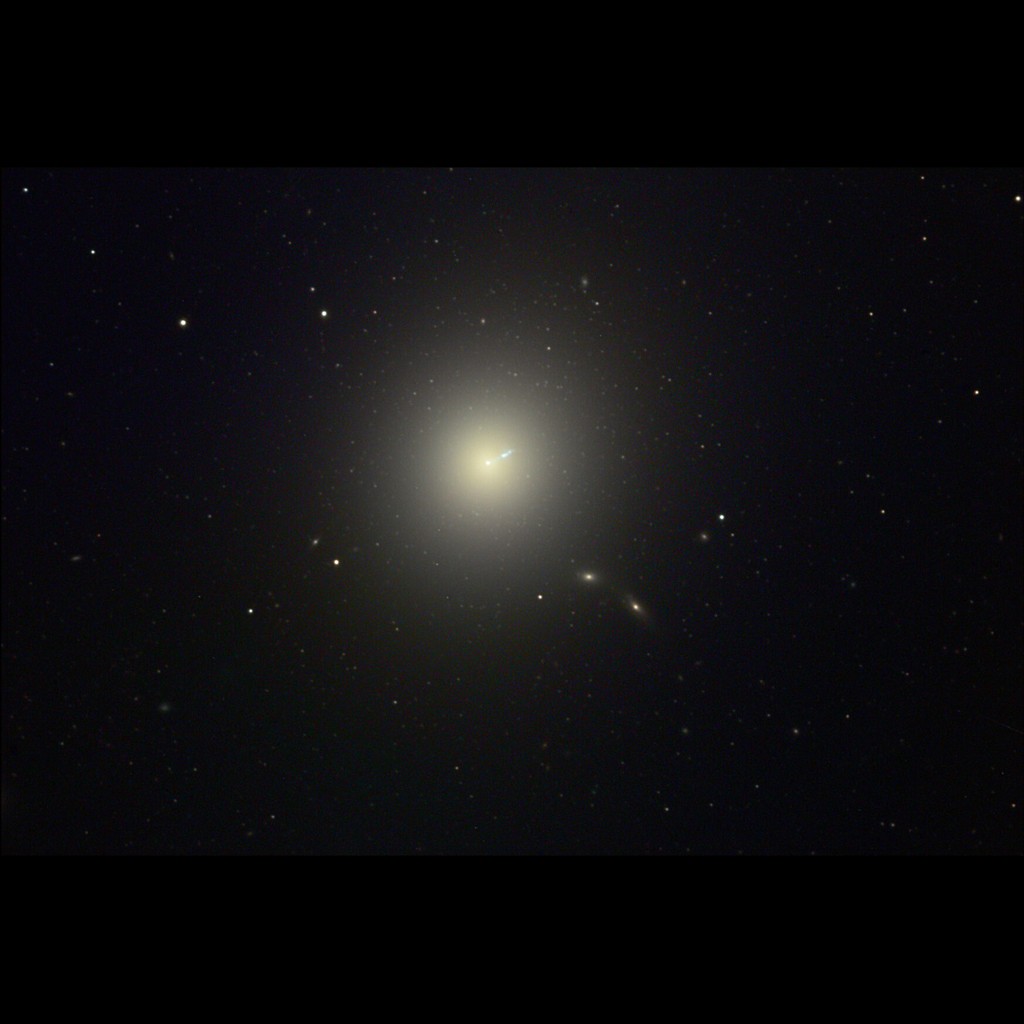
Messier 87 (NGC 4486), also known as Virgo A, is the dominant galaxy of the Virgo Cluster — a colossal elliptical system lying approximately 54 million light-years away in the constellation Virgo. Charles Messier catalogued it on March 18, 1781. NGC 4486 is spherical in form and roughly 120,000 light-years in diameter, but because it is a sphere rather than a flat disk its total mass is staggering: astronomers estimate over 2 trillion solar masses — far greater than the Milky Way. Embedded in M87's outer halo are thousands of globular clusters, visible as tiny fuzzy points in deep images, numbering over 12,000 — one of the richest globular cluster systems known.
The most remarkable feature of NGC 4486 is a luminous jet erupting from its nucleus: a narrow, collimated stream of electrons and magnetic field accelerated to nearly the speed of light by the galaxy's central supermassive black hole — a monster of 6.5 billion solar masses. In 2019, the Event Horizon Telescope collaboration produced the world's first direct image of a black hole's shadow, using M87 as their target — a landmark in the history of astronomy. The jet extends thousands of light-years and is detectable from radio waves through optical light and X-rays, making M87 one of the most powerful natural particle accelerators in the Universe.
In binoculars M87 appears as a round, bright smudge; a small telescope shows a compact, intensely concentrated nucleus embedded in a halo of diffuse light. The jet is not visible visually but can be detected in long-exposure photographs. This image was taken as part of the Advanced Observing Program (AOP) at the Kitt Peak Visitor Center in 2014.
Navigate from Spica toward Virgo. In the heart of the Virgo Cluster — slightly south of the M84/M86 pair.
| Star | Bayer | Mag | Spectral Type | Distance | Meaning |
|---|---|---|---|---|---|
| Denebola | — | 2.14 | A3 · White main sequence | 36 ly | Arabic Dhanab al-Asad, 'Tail of the Lion' — marks the lion's tail. One of the few stars where infrared excess suggests a debris disk. |
| Vindemiatrix | — | 2.85 | G8 · Yellow giant | 102 ly | Latin for 'The Grape Gatherer' — its heliacal rising in ancient times signaled the grape harvest season in the Mediterranean. |