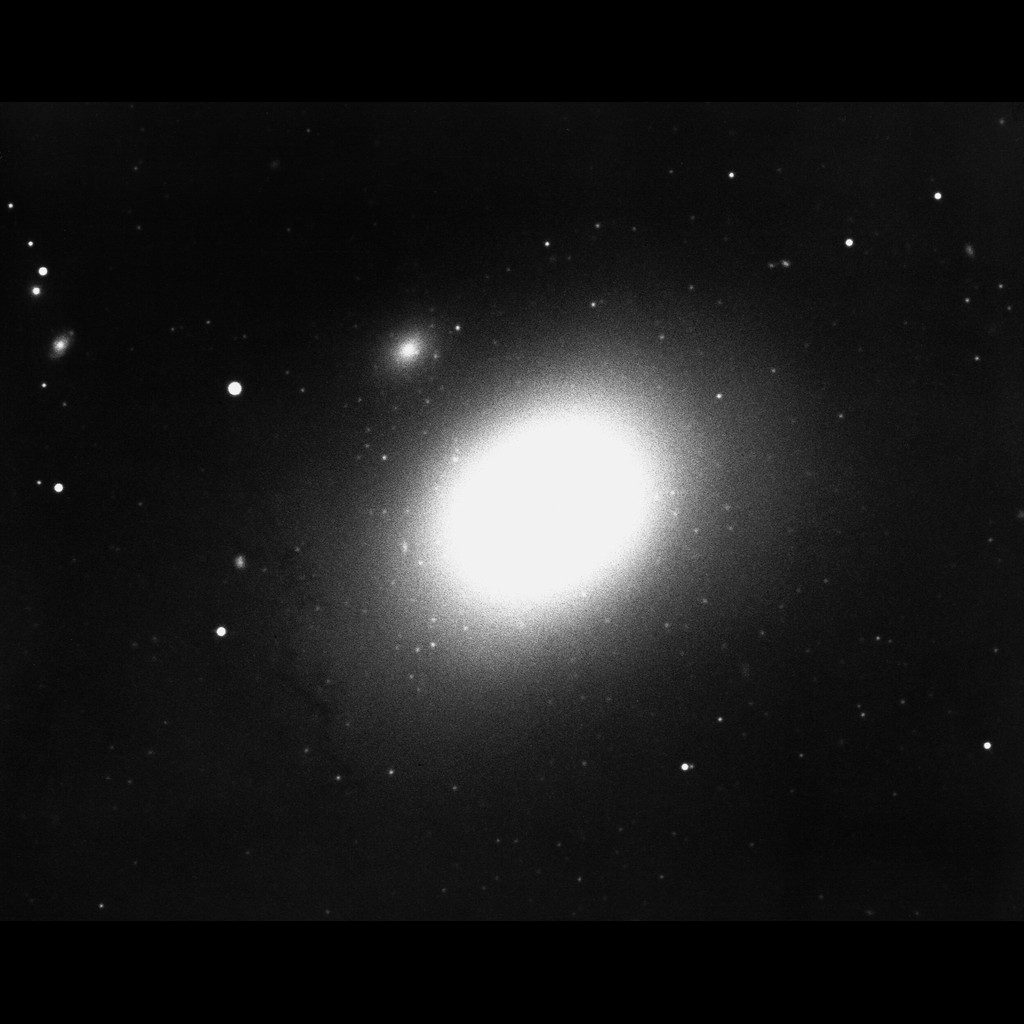
NOIRLab/NSF/AURA
| Type | Galaxy | Constellation | Vir |
|---|---|---|---|
| Magnitude | 8.9 | Size | 8.9′ |
| Distance | 52.0 million light-years | Best Month | May |
| Visibility | Global | Difficulty | Moderate (level 3/4) |
| Min. Aperture | 3in | RA / Dec | 12h 26m 13.2s · +12° 56' 60" |
| Discovered by | Charles Messier, 1781 | ||
NOIRLab/NSF/AURA
Messier 86 (NGC 4406) is a large lenticular galaxy — some astronomers classify it as an elliptical — in the constellation Virgo, approximately 60 million light-years away and a prominent member of the Virgo Cluster of galaxies. Charles Messier discovered it on March 18, 1781. NGC 4406 lies very close on the sky to M84 and both are core members of the central Virgo Cluster, together forming the prominent bright pair at the heart of the famous "Markarian's Chain" — a curving line of galaxies visible in the same wide-field telescope view. Despite their similar appearance, M84 and M86 are likely at somewhat different distances within the cluster itself.
One of M86's most distinctive astrophysical properties is its motion: unlike the vast majority of galaxies, which show redshifted spectra indicating they are moving away from us as the Universe expands, NGC 4406 has one of the largest known blueshifts of any Messier object. It is falling through the Virgo Cluster toward the Milky Way at roughly 400 kilometers per second relative to our line of sight — a sign of its infall trajectory within the cluster's gravitational potential well. Deep X-ray images show hot gas being stripped from NGC 4406 as it plows through the cluster's hot intracluster medium — a ram-pressure stripping event that leaves a long tail of X-ray emission trailing behind the galaxy.
In a small telescope M86 appears as a bright, oval glow adjacent to M84; the two make a striking visual pair at moderate magnification in any telescope, embedded among the other galaxies of the Virgo Cluster. This image was made at the Kitt Peak National Observatory 4-meter Mayall telescope in 1975.
Navigate from Spica toward Virgo. Just 0.3° east of M84 — both in the same field, part of Markarian's Chain.
| Star | Bayer | Mag | Spectral Type | Distance | Meaning |
|---|---|---|---|---|---|
| Denebola | — | 2.14 | A3 · White main sequence | 36 ly | Arabic Dhanab al-Asad, 'Tail of the Lion' — marks the lion's tail. One of the few stars where infrared excess suggests a debris disk. |
| Zosma | β Leo | 2.56 | A4 · White subgiant | 58 ly | Greek for 'Girdle' — marks the hip of Leo the Lion. An aging star beginning to expand into a subgiant, slowly leaving the main sequence. |
| Vindemiatrix | — | 2.85 | G8 · Yellow giant | 102 ly | Latin for 'The Grape Gatherer' — its heliacal rising in ancient times signaled the grape harvest season in the Mediterranean. |