The Dark Side Observatory
| Type | Globular Cluster | Constellation | Del |
|---|---|---|---|
| Magnitude | 10.6 | Size | 2.8′ |
| Distance | 135,900 light-years | Best Month | August |
| Visibility | Northern | Difficulty | Challenging (level 4/4) |
| Min. Aperture | 6in | RA / Dec | 21h 01m 30.0s · +16° 10' 48" |
| Discovered by | William Herschel, 1784 | ||
The Dark Side Observatory
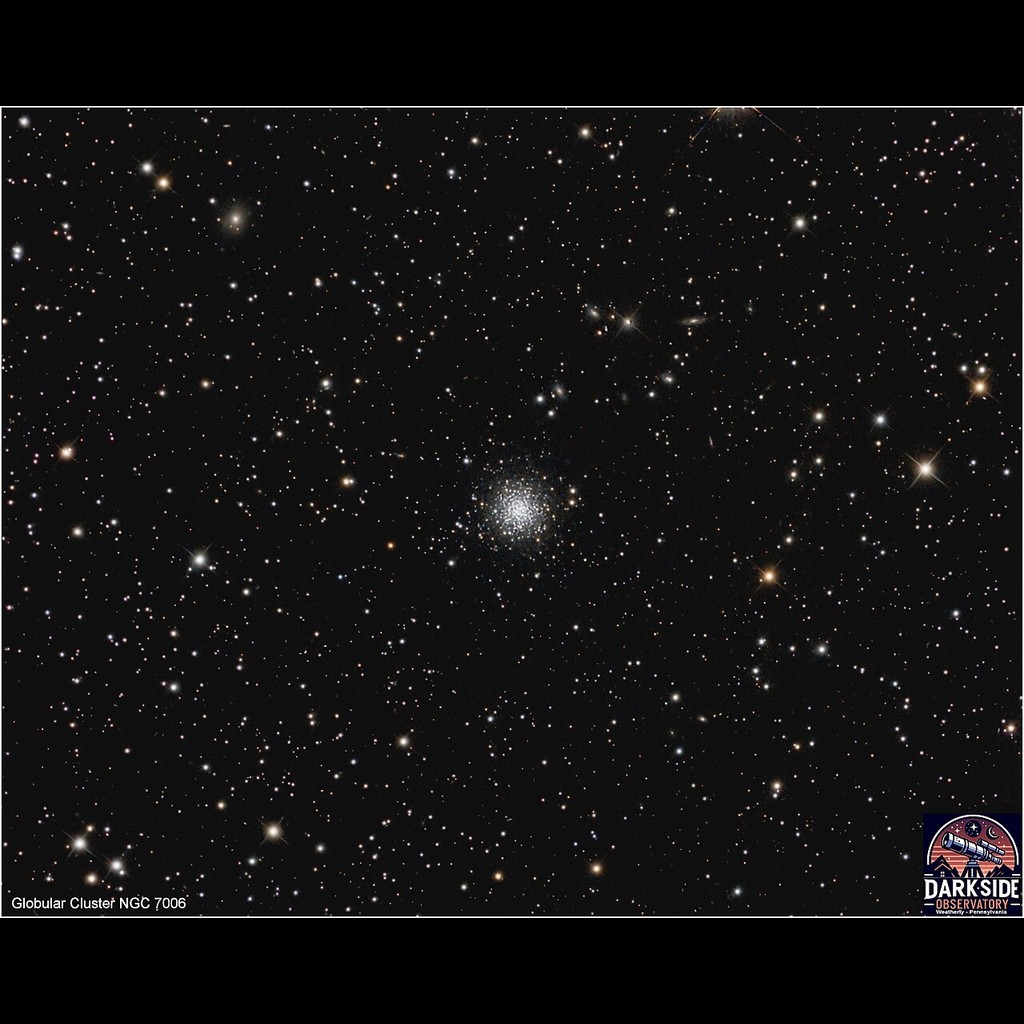
Caldwell 42, or NGC 7006, is a compact globular cluster in the constellation Delphinus that serves as a lonely sentinel on the Milky Way's frontier. Located approximately 135,000 light-years away—five times the distance from the Sun to the galactic center—it resides deep within the galactic halo. This sparsely populated outer shell of our galaxy is a vast, spherical realm composed of dark matter, ancient gas, and a few scattered stellar clusters that survived the early universe.
As a Type I cluster, NGC 7006 features an exceptionally high concentration of stars at its core. Despite its massive physical scale, its extreme distance makes it a challenging target for observers, appearing with a modest apparent magnitude of 10.6 and spanning just 2.8 arcminutes. While it looks like a dim, nebulous star through a telescope, long-exposure photography reveals its true identity as a shimmering ball of ancient suns held together by gravity at the edge of the galaxy.
This high-resolution image was captured on June 12, 2024, at The Dark Side Observatory (W59) in Weatherly, PA. The final result is a product of 120 sixty-second exposures processed in PixInsight, utilizing an Orion 8” RC telescope and a ZWO ASI2600MC camera cooled to 0°F. Mounted on a pier-supported Celestron CGEM-DX and controlled via ASIAir Pro, the setup provided the precision tracking necessary to resolve the cluster's dense, distant core under Bortle 4 skies.
From Enif: From Enif (Epsilon Pegasi), move 4° east into the small constellation Delphinus.
| Star | Bayer | Mag | Spectral Type | Distance | Meaning |
|---|---|---|---|---|---|
| Altair | α Aql | 0.76 | A7 · White main sequence | 17 ly | Arabic Al-Nasr al-Tā'ir, 'The Flying Eagle.' One of the three stars of the Summer Triangle, it spins so fast it is noticeably flattened at the poles. |
| Enif | — | 2.38 | K2 · Orange supergiant | 690 ly | Arabic Al-Anf, 'The Nose' of the horse — marks the muzzle of Pegasus. A supergiant that varies irregularly in brightness. |
| Alshain | θ Aql | 3.71 | G8 · Yellow subgiant | 45 ly | Persian Shahīn, 'The Peregrine Falcon' — flanks Altair in Aquila, part of the trio of stars that make the eagle's body. |