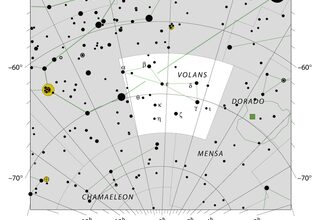
 IAU Chart
 NOIRLab Images
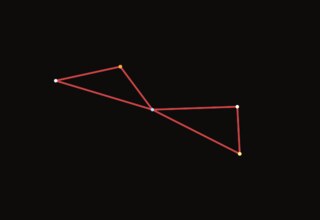 Stars and Sticks
| Abbreviation | Vol |
|---|---|
| Meaning | Flying Fish |
| Pronunciation Guide is based on “Pronouncing Astronomical Names,” published in 1943 by the American Astronomical Society. | VO-lanz |
| Genitive The genitive is the Latin possessive form used in star names. For example, Alpha Orionis means “the Alpha of Orion.” | voh-LAN-tis |
| Best Month | March |
| Visibility | Southern |
| Origin | ExplorationCreated by 16th-century Dutch navigators (Keyser & de Houtman) to fill the blank spaces of the southern sky during their voyages to the East Indies. |
| Author | Keyser & de HoutmanDutch explorers whose southern star observations during the first Dutch expedition to the East Indies provided the data for 12 new constellations. |
| Type | constellation |
| Difficulty | Expert |
| Description | The Flying Fish was created by Dutch navigators Keyser and de Houtman in the 1590s, representing the remarkable tropical fish that launch themselves from the ocean surface and glide up to 200 meters on wing-like pectoral fins to escape predators — a behavior that astonished European sailors encountering them for the first time. It is depicted in the sky being chased by the neighboring Dorado (the Dolphinfish), its primary predator. The constellation contains the Lindsay-Shapley Ring (AM0644-741) — a spectacular ring galaxy formed by a head-on collision with another galaxy, about 300 million light-years away and one of the finest examples of a collisional ring galaxy known. |
| Asterism | The Flying Fish: A small, diamond-like pattern of stars. |
Click a thumbnail to view full-size. Plain and Annotated versions available on the image page.
Images: NOIRLab/NSF/AURA/E. Slawik · IAU and Sky & Telescope · Stellarium — Full credits →