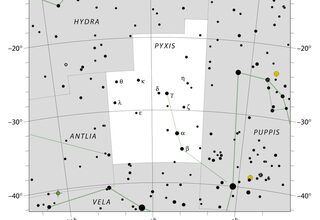
 IAU Chart
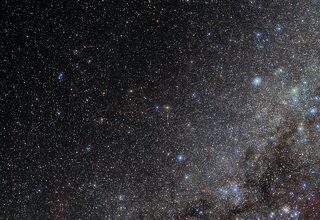 NOIRLab Images
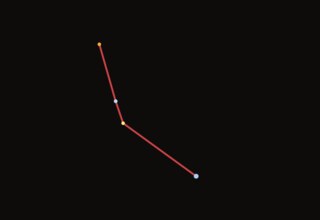 Stars and Sticks
| Abbreviation | Pyx |
|---|---|
| Meaning | Mariner's Compass |
| Pronunciation Guide is based on “Pronouncing Astronomical Names,” published in 1943 by the American Astronomical Society. | PIX-iss |
| Genitive The genitive is the Latin possessive form used in star names. For example, Alpha Orionis means “the Alpha of Orion.” | PIK-sih-dis |
| Best Month | March |
| Visibility | Southern |
| Origin | EnlightenmentNamed by Nicolas-Louis de Lacaille in the 1750s; these represent the scientific and artistic tools of the "Age of Reason". |
| Author | LacailleKnown as the "Father of Southern Astronomy," he mapped nearly 10,000 stars and created 14 new constellations in the southern hemisphere. |
| Type | constellation |
| Difficulty | Expert |
| Description | The Mariner's Compass was added by Lacaille in the 1750s using stars in the region of Argo Navis that had previously been unassigned — strictly speaking it was not part of the original ancient ship but Lacaille's own addition. The constellation contains T Pyxidis — a remarkable recurrent nova, a binary system in which a white dwarf regularly accumulates enough matter from its companion to trigger a thermonuclear explosion on its surface, briefly brightening to naked-eye visibility. T Pyxidis has been recorded erupting in 1890, 1902, 1920, 1944, 1966, and 2011, making it one of the most closely watched stellar objects in the sky. |
Click a thumbnail to view full-size. Plain and Annotated versions available on the image page.
Images: NOIRLab/NSF/AURA/E. Slawik · IAU and Sky & Telescope · Stellarium — Full credits →