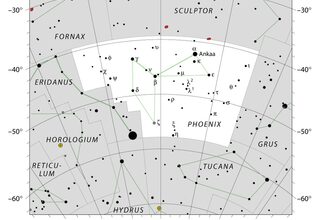
 IAU Chart
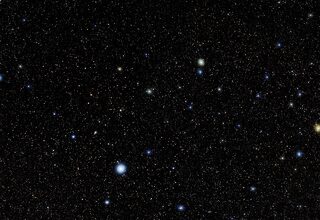 NOIRLab Images
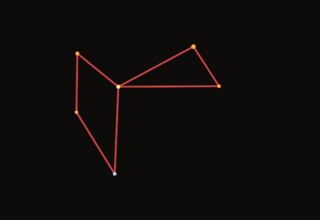 Stars and Sticks
| Abbreviation | Phe |
|---|---|
| Meaning | Phoenix |
| Pronunciation Guide is based on “Pronouncing Astronomical Names,” published in 1943 by the American Astronomical Society. | FEE-nix |
| Genitive The genitive is the Latin possessive form used in star names. For example, Alpha Orionis means “the Alpha of Orion.” | fee-NYE-sis |
| Best Month | November |
| Visibility | Southern |
| Origin | ExplorationCreated by 16th-century Dutch navigators (Keyser & de Houtman) to fill the blank spaces of the southern sky during their voyages to the East Indies. |
| Author | Keyser & de HoutmanDutch explorers whose southern star observations during the first Dutch expedition to the East Indies provided the data for 12 new constellations. |
| Type | constellation |
| Difficulty | Moderate |
| Description | Named after the legendary firebird of ancient Egyptian and Greek mythology — a unique creature that lived for 500 years before building a funeral pyre, bursting into flames, and rising reborn from its own ashes. As a symbol of immortality and rebirth, the phoenix appeared in cultures from ancient Egypt (the Bennu bird sacred to Ra) to China (the Fenghuang) to Rome. Created by Dutch navigators in the 1590s, it sits in the southern sky. The brightest star, Ankaa (Alpha Phoenicis), derives its name from the Arabic word for the phoenix itself; it is an orange giant about 77 light-years away. The constellation contains the Robert's Quartet — four galaxies in a complex gravitational interaction. |
Click a thumbnail to view full-size. Plain and Annotated versions available on the image page.
Images: NOIRLab/NSF/AURA/E. Slawik · IAU and Sky & Telescope · Stellarium — Full credits →