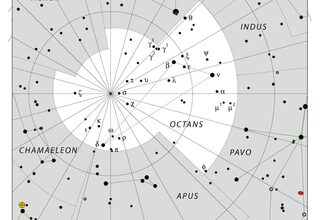
 IAU Chart
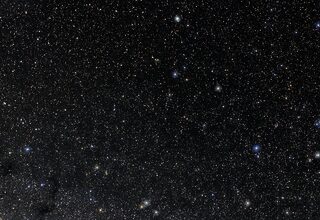 NOIRLab Images
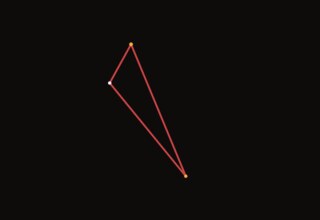 Stars and Sticks
| Abbreviation | Oct |
|---|---|
| Meaning | Octant |
| Pronunciation Guide is based on “Pronouncing Astronomical Names,” published in 1943 by the American Astronomical Society. | OCK-tanz |
| Genitive The genitive is the Latin possessive form used in star names. For example, Alpha Orionis means “the Alpha of Orion.” | ok-TAN-tis |
| Best Month | October |
| Visibility | Southern |
| Origin | EnlightenmentNamed by Nicolas-Louis de Lacaille in the 1750s; these represent the scientific and artistic tools of the "Age of Reason". |
| Author | LacailleKnown as the "Father of Southern Astronomy," he mapped nearly 10,000 stars and created 14 new constellations in the southern hemisphere. |
| Type | constellation |
| Difficulty | Expert |
| Description | The Octant — a navigational instrument used to measure the angle of stars above the horizon — was named by Lacaille to honor the invention that made precise celestial navigation possible. The constellation has the unique distinction of containing the South Celestial Pole — the point around which the entire southern sky rotates — making it the southern counterpart of Ursa Minor. Unlike the north which has the relatively bright Polaris, the south pole star Sigma Octantis is a dim magnitude 5.4 star barely visible to the naked eye, roughly 270 light-years away — making southern navigation by pole star far less convenient than its northern equivalent. |
Click a thumbnail to view full-size. Plain and Annotated versions available on the image page.
Images: NOIRLab/NSF/AURA/E. Slawik · IAU and Sky & Telescope · Stellarium — Full credits →