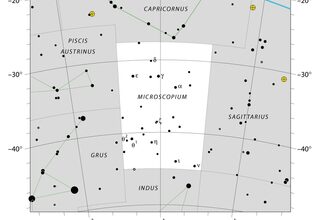
 IAU Chart
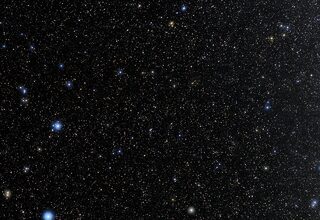 NOIRLab Images
| Abbreviation | Mic |
|---|---|
| Meaning | Microscope |
| Pronunciation Guide is based on “Pronouncing Astronomical Names,” published in 1943 by the American Astronomical Society. | my-cruh-SCOPE-ee-um |
| Genitive The genitive is the Latin possessive form used in star names. For example, Alpha Orionis means “the Alpha of Orion.” | my-kroh-SKOH-pee-eye |
| Best Month | September |
| Visibility | Southern |
| Origin | EnlightenmentNamed by Nicolas-Louis de Lacaille in the 1750s; these represent the scientific and artistic tools of the "Age of Reason". |
| Author | LacailleKnown as the "Father of Southern Astronomy," he mapped nearly 10,000 stars and created 14 new constellations in the southern hemisphere. |
| Type | constellation |
| Difficulty | Expert |
| Description | The Microscope was introduced by Lacaille in the 1750s to honor the compound microscope, the instrument that was revealing an entire invisible world of microorganisms and transforming medicine and biology during the Age of Enlightenment. It occupies a faint, unremarkable region of sky south of Capricornus. The most notable object is AU Microscopii — a young red dwarf star just 32 light-years away surrounded by a debris disk of dust and rocks; it is one of the youngest and nearest stars with a confirmed planetary system, a prime target for studying how solar systems form in their early stages. |
Click a thumbnail to view full-size. Plain and Annotated versions available on the image page.
Images: NOIRLab/NSF/AURA/E. Slawik · IAU and Sky & Telescope · Stellarium — Full credits →