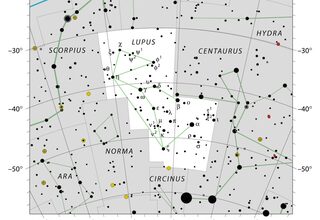
 IAU Chart
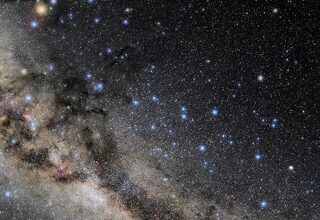 NOIRLab Images
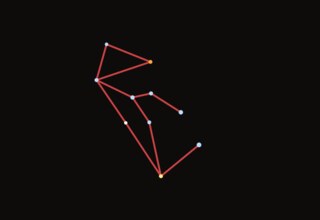 Stars and Sticks
| Abbreviation | Lup |
|---|---|
| Meaning | Wolf |
| Pronunciation Guide is based on “Pronouncing Astronomical Names,” published in 1943 by the American Astronomical Society. | LOOP-us |
| Genitive The genitive is the Latin possessive form used in star names. For example, Alpha Orionis means “the Alpha of Orion.” | LOO-pye |
| Best Month | June |
| Visibility | Southern |
| Origin | AncientThese figures are rooted in the classical Greek and Mesopotamian traditions cataloged by Ptolemy in the 2nd century AD. |
| Author | PtolemyPtolemy, a 2nd-century Greco-Egyptian astronomer, cataloged the 48 classical constellations in his landmark work, the Almagest. These form the core of the 88 modern constellations recognized today. |
| Type | constellation |
| Difficulty | Challenging |
| Description | The Wolf is one of Ptolemy's original 48 constellations, yet the ancient Greeks gave it no name — it was simply 'the beast' being offered by the neighboring Centaur. Only in Roman times was it specifically identified as a wolf. The constellation came to attention in 1006 CE when one of the brightest supernovae in recorded history blazed within its borders, reaching a magnitude of -7.5 — about a quarter as bright as the full Moon — and visible in daylight for weeks. Ancient records from China, Japan, Egypt, and Europe all document this spectacular event, and the remnant of that explosion has been identified and is still expanding today. |
Click a thumbnail to view full-size. Plain and Annotated versions available on the image page.
Images: NOIRLab/NSF/AURA/E. Slawik · IAU and Sky & Telescope · Stellarium — Full credits →