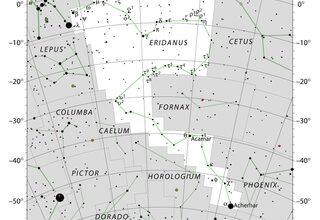
 IAU Chart
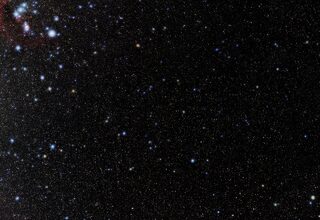 NOIRLab Images
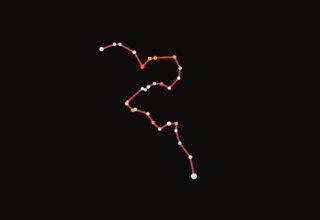 Stars and Sticks
| Abbreviation | Eri |
|---|---|
| Meaning | River |
| Pronunciation Guide is based on “Pronouncing Astronomical Names,” published in 1943 by the American Astronomical Society. | ih-RID-an-nuss |
| Genitive The genitive is the Latin possessive form used in star names. For example, Alpha Orionis means “the Alpha of Orion.” | ih-RID-uh-nye |
| Best Month | December |
| Visibility | Global |
| Origin | AncientThese figures are rooted in the classical Greek and Mesopotamian traditions cataloged by Ptolemy in the 2nd century AD. |
| Author | PtolemyPtolemy, a 2nd-century Greco-Egyptian astronomer, cataloged the 48 classical constellations in his landmark work, the Almagest. These form the core of the 88 modern constellations recognized today. |
| Type | constellation |
| Difficulty | Moderate |
| Description | Eridanus is the sixth largest constellation, winding over 60 degrees across the southern sky in a great meandering river that begins near Orion's foot and ends at the brilliant star Achernar near the south celestial pole. In myth it is the river into which the reckless Phaethon fell after losing control of the sun chariot from his father Helios — Zeus struck him down with a thunderbolt before all life on Earth was scorched. Achernar, marking the river's end, is the ninth brightest star in the sky and one of the most oblate stars known — spinning so rapidly that its equatorial diameter is 56% larger than its polar diameter. The constellation also contains Epsilon Eridani, just 10.5 light-years away and one of the nearest Sun-like stars. |
Click a thumbnail to view full-size. Plain and Annotated versions available on the image page.
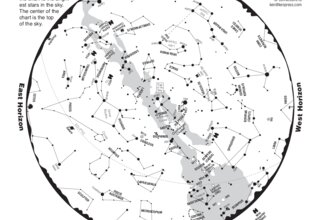
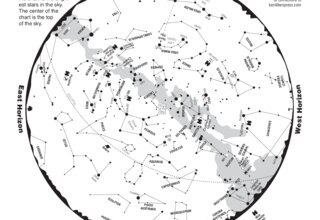
Monthly sky charts courtesy of What's Out Tonight? — Copyright ©2026 Ken Graun. Star charts are optimized for mid-latitudes of the Northern Hemisphere. Click a chart to view or download the PDF. For guidance on using the chart, or to purchase a planisphere and astronomy books, visit kenpress.com.
Images: NOIRLab/NSF/AURA/E. Slawik · IAU and Sky & Telescope · Stellarium — Full credits →